For twenty years, advertisers targeted users using third-party cookies those tiny trackers that followed web users from site to site. That system is slowly closing. Not all at once, but through continuous erosion: stricter web browsers, heavier regulations, and users simply saying no.
The answer comes down to three words: first-party data. The data you harvest yourself, with your customers' consent, is becoming your most valuable asset. It is more reliable, more compliant, and no one can cut off your access to it.
We will define the different types of data, look at exactly where things stand with cookies, and see how to collect and activate your first-party data in advertising.
Article summary
- First-party data: definition
- First, second, third, and zero-party: the differences
- Third-party cookies: where do things actually stand?
- Why first-party data is becoming central
- How to collect your first-party data
- How to activate it in advertising
First-party data: definition
🍪 First-party data (Owned data)It encompasses all the information you collect directly from your customers and prospects on your own channels: your website, your mobile app, your CRM, your loyalty program, or your newsletters. Concretely, this includes past purchases, pages visited on your domain, preferences declared upon registration, and order histories.
Its two major qualities: it belongs to you, and it reflects the actual behavior of your customers with your brand, not an estimate purchased from an outside party.
It is this combination of ownership and reliability that makes it the foundation of modern advertising. No one can strip you of it, and it is far more accurate than aggregated audience segments.
First, second, third, and zero-party: the differences
Four terms circulate, often confused with one another. Here is how to distinguish them.
| Type | Origin | Reliability |
|---|
| Zero-party | Proactively declared by the customer (preferences, intentions) | Very high |
| First-party | Collected across your owned channels (purchases, browsing) | High |
| Second-party | First-party data from a partner, shared with you | Good |
| Third-party | Purchased from data brokers | Variable, declining |
Zero-party data deserves a special mention. This is what the customer shares with you intentionally, such as by responding to a preference quiz. It is even more reliable than first-party data because it is declared rather than inferred.
Third-party cookies: where do things actually stand?
Let's be precise, because this topic has evolved significantly. Contrary to its repeated announcements since 2020, Google ultimately backed out in April 2025 from deprecating third-party cookies in Chrome. The browser now shifts the choice over to the user rather than blocking them by default.
But make no mistake: this about-face does not save third-party cookies. Safari and Firefox already block them by default. On Chrome, their effectiveness is shrinking progressively, and when left with the choice, roughly 40% of internet users opt out of tracking, according to the CNIL. Add to this a GDPR framework that demands explicit consent, and you get a third-party cookie asset that is less and less available.
The consensus among industry observers is clear: even without a sudden technical ban, third-party cookies are dying a slow death. The momentum behind first-party data hasn't shifted an inch. Brands investing in it today are gaining a competitive edge.
>>> To learn more about the deprecation of third-party cookies, click here!
Why first-party data is becoming central
Three main reasons make this transition imperative:
1. Reliability The match rate of a customer via first-party data reaches 92%, compared to just 65% for aggregated third-party data. You target accurately, not approximately.
2. Cost A McKinsey study estimates that companies unable to replace third-party insights with first-party signals could see their ad spend rise by 20% to secure the exact same results. Conversely, a rich owned database lowers your campaign costs.
3. Compliance Relying on information that the customer intentionally shared with you greatly simplifies your GDPR alignment and strongly reduces legal risk. You no longer depend on opaque data processing managed by third parties.
💡 Relying on information that the customer intentionally shared with you greatly simplifies your GDPR alignment and strongly reduces legal risk. You no longer depend on opaque data processing managed by third parties.
How to collect your first-party data
Data collection cannot simply be decreed; it must be earned. The underlying rule is simple: offer real value in exchange for information.
📌 Encourage account creation, newsletter sign-ups, or loyalty program enrollment by offering a concrete trade-off: premium content, personalized offers, or an actual perk. A customer who understands what they gain will willingly share their data.
Two conditions are required for this to work:
- A clear consent interface, where the user knows exactly what they are sharing and why.
- A single data repository to centralize these insights, ensuring a unified customer view across all your systems. Data scattered across ten different platforms is virtually useless.
How to activate it in advertising
Collecting is only half the journey. First-party data gains its full value when you activate it within your campaigns.
⚙️ The basic mechanism Send your CRM and conversion data back to your advertising platforms. This allows you to build custom audiences of your best customers, target high-value prospects, or build lookalike audiences to find new users matching your ideal profile. Feeding back your conversions also improves automated campaign optimization.
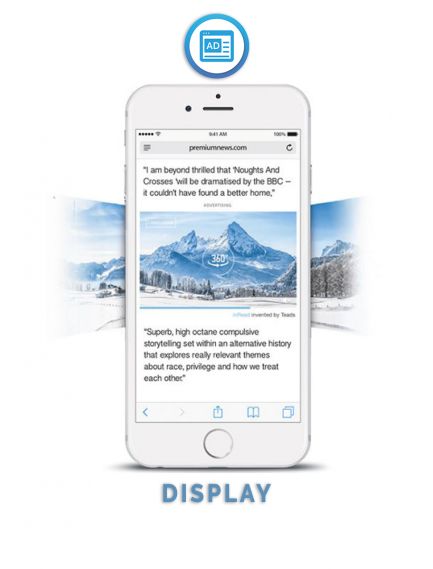
🎯 A key point: synergy First-party data does not solve everything. To reach completely unknown audiences, display and programmatic channels combined with contextual targeting take over. Contextual advertising delivers ads based on the content of the webpage, without needing any personal data. ⚡ The winning duo: first-party for your known customers, contextual for net-new acquisition.
This synergy aligns perfectly with a coherent
cross-channel strategy, where each data source serves the right objective.
Summary table
| Question | Short answer |
|---|
| What is first-party data? | Your customer information collected across your own channels |
| Reliability vs. third-party | 92% match rate compared to 65% |
| Third-party cookie status | Not forcefully deprecated, but steadily declining |
| Ideal complement | Contextual targeting |
Turn your data into an advantage
First-party data is not just a defensive fallback against the twilight of cookies. It is an offensive asset: the better you know your customers, the more precise and profitable your campaigns become.
>>> Discover our programmatic display solutions
>>> Submit your brief on Adintime




 Top 30 best ad musics of all time (Updated 2026)
 The influence of advertising on purchasing behavior
 What is commercial advertising?
 Top 5 colors to use for creating your advertising posters | Adintime
 Facebook Ads Library: The ultimate guide to winning campaigns
 Movember : How brands can get involved without a misstep ?
 How to build an effective media strategy in 2026
 The AIDA model in advertising : Definition and examples
 First-party data : Definition and challenges in the cookieless era
 Customer Acquisition Cost (CAC) : Calculation and optimization