New ! Find your advertising panels at a glance  DISCOVER

Brand content : definition, examples and checklist to get started

Pôle Marketing

Want to save time ?

Get this article summarized in seconds with AI

Article summary: Brand content

💡 What the numbers say

  • Brand content generates leads 4.1 times cheaper than paid advertising after 12 months of regular production (Big Neurons, 2026)
  • 92% of marketers who invest in content marketing report a positive return (HubSpot, 2025)
  • A brand + performance mix improves total ROI by 25% to 100% compared to performance alone, and cutting branding can reduce ROI by up to 40% (WARC)

📊 Brand content vs advertising: two different logics

  • Advertising interrupts. Brand content attracts, by offering informational, educational, or entertaining value that makes the brand desirable even before the purchase
  • The ROI of brand content is delayed: the crossover point with the paid cost per lead arrives at a median of 7.3 months after launch
  • In 2026, 60% of searches end without a click (Semrush): being cited by generative AIs has become as important as ranking on Google

🎯 The formats that perform in 2026

  • Long-form articles (2,000+ words): 2.8 times more leads per 1,000 visitors than short articles
  • Video: 91% of companies use it as a marketing format, and it can increase organic traffic by +70%
  • Structured FAQ content with schema.org markup: 3.4 times more citations in generative AI answers

Brand content is not a trend. It is a response to a structural problem in the advertising market: media costs have increased by 35% in five years, conversion rates are declining, and audiences have grown accustomed to ignoring traditional advertising formats. In this context, producing content that attracts rather than interrupts has become as much a defensive strategy as an offensive one.

But brand content is also often misunderstood. It is confused with content marketing, with editorial advertising, with public relations. And above all, its temporal logic is underestimated: brand content costs more per lead than paid advertising during the first 7 months. From the 8th month onward, the curve reverses, and it continues to improve as long as you publish.

This guide explains what brand content really is, how to distinguish it from advertising content, which formats work, and how to structure a strategy with an operational checklist.

Article summary

  1. What is brand content? Precise definition ?
  2. Brand content vs advertising vs content marketing: the real differences
  3. The ROI of brand content: a medium-term logic
  4. The formats that perform in 2026
  5. Brand content and GEO: being cited by AIs
  6. 3 examples of brand content that work
  7. Checklist to launch your brand content strategy
  8. How to measure brand content ?
  9. Summary table of formats
  10. FAQ

What is brand content? Precise definition

The official French definition comes from the Official Journal of February 14, 2024 (FranceTerme): brand content is a "set of editorial-looking messages produced by an organization for communication purposes, distributed by the brand itself or by a third party, whether or not this third party participated in the creation."

What distinguishes brand content from traditional advertising is the editorial appearance. Brand content presents itself as content that brings something to the person consuming it—information, a story, entertainment, expertise—regardless of the fact that it is produced by a brand.

The English term "brand content" or "branded content" has established itself in French professional usage, even though the Académie Française recommends "contenu de marque."

Brand content vs advertising vs content marketing: the real differences

These three concepts overlap, and confusion is common. Here is a clear way to tell them apart.

Concept Approach & Function
📣 Advertising Advertising interrupts. It buys space or time to expose a message to an audience that did not ask for it. Its effectiveness relies on repetition and memorization. It acts quickly, but its effect stops when the budget stops.
✨ Brand Content Brand content attracts. It creates content that the audience chooses to consume because it brings them value. Its effectiveness relies on perceived value (informational, educational, entertaining). It acts more slowly, but its effects are long-lasting.
🎯 Content Marketing Content marketing is the overall strategy that encompasses the creation, distribution, and measurement of any content for marketing purposes. Brand content is a type of content produced within this strategy, focused on the brand and its universe, rather than on direct conversion.

The ROI of brand content: a medium-term logic

This is the point that many executives and CFOs find hard to accept: brand content costs more per lead than paid advertising during the first few months. This is structural, not a sign of failure.

According to the French Brand Content Benchmark 2026 by Big Neurons, which covers 31 missions carried out between 2022 and 2025, the cost per lead from organic traffic is 4.1 times lower than the cost per lead via Meta Ads or Google Ads, but only after 12 months of regular production. The crossover point arrives at a median of 7.3 months.

What this implies concretely: a brand content strategy requires a long-term commitment. Organizations that give up after 3 or 4 months miss out on the crossover point. Those that hold out for 12 months benefit from an editorial asset that generates leads at a decreasing marginal cost.

To this direct ROI is added the halo effect identified by WARC: a brand + performance mix improves total ROI by 25% to 100% compared to an exclusively performance-based strategy. And cutting branding can reduce overall ROI by up to 40%, with negative effects observable as early as 4 to 6 weeks.

>>> Here is how to calculate the ROI of marketing campaigns

The formats that perform in 2026

Not all brand content formats are created equal depending on the objective pursued. Here are the most effective ones in 2026.

Long-form articles (guides, analyses, comparisons): articles of more than 2,000 words generate 2.8 times more leads per 1,000 visitors than articles of less than 1,000 words (Big Neurons, 2026).

Video: 91% of companies now use video as a marketing format (ISCOM, 2026). Integrating videos into articles can increase organic traffic by 70%.

Data content and industry studies: these are the best candidates for citations by the media, other websites, and AIs. Adintime regularly publishes data on ad space prices and purchase volumes: this is exactly that type of content.

Newsletter: an excellent loyalty lever, less dependent on social algorithms than networks. Email marketing boasts an ROI of 3,600% (36 euros for every euro invested).

UGC (User-Generated Content) and employee advocacy: user-generated content generates 4 times higher click-through rates than other content, and 93% of marketers judge it more effective. For brands wanting to amplify their UGC via creators, the logic aligns with that of influence marketing. On the employee advocacy side: only 3% of employees share content about their company, but when they do, engagement increases by 30% and CTR is multiplied by two (LinkedIn, cited by Brandwatch, 2026).

Brand content and GEO: being cited by AIs in 2026

In 2026, 60% of searches end without a click on Google (Semrush). Users get their answers directly in search, via Featured Snippets, SGE (Search Generative Experience) results, or increasingly via generative AIs like ChatGPT, Claude, or Perplexity.

According to the French Brand Content Benchmark 2026, brands that publish structured FAQ content with schema.org FAQPage markup get 3.4 times more citations in generative AI responses. Setting up an llms.txt file improves AI citations by a median of +67%.

>>> Discover how to use AI for your marketing campaigns

3 examples of brand content that work

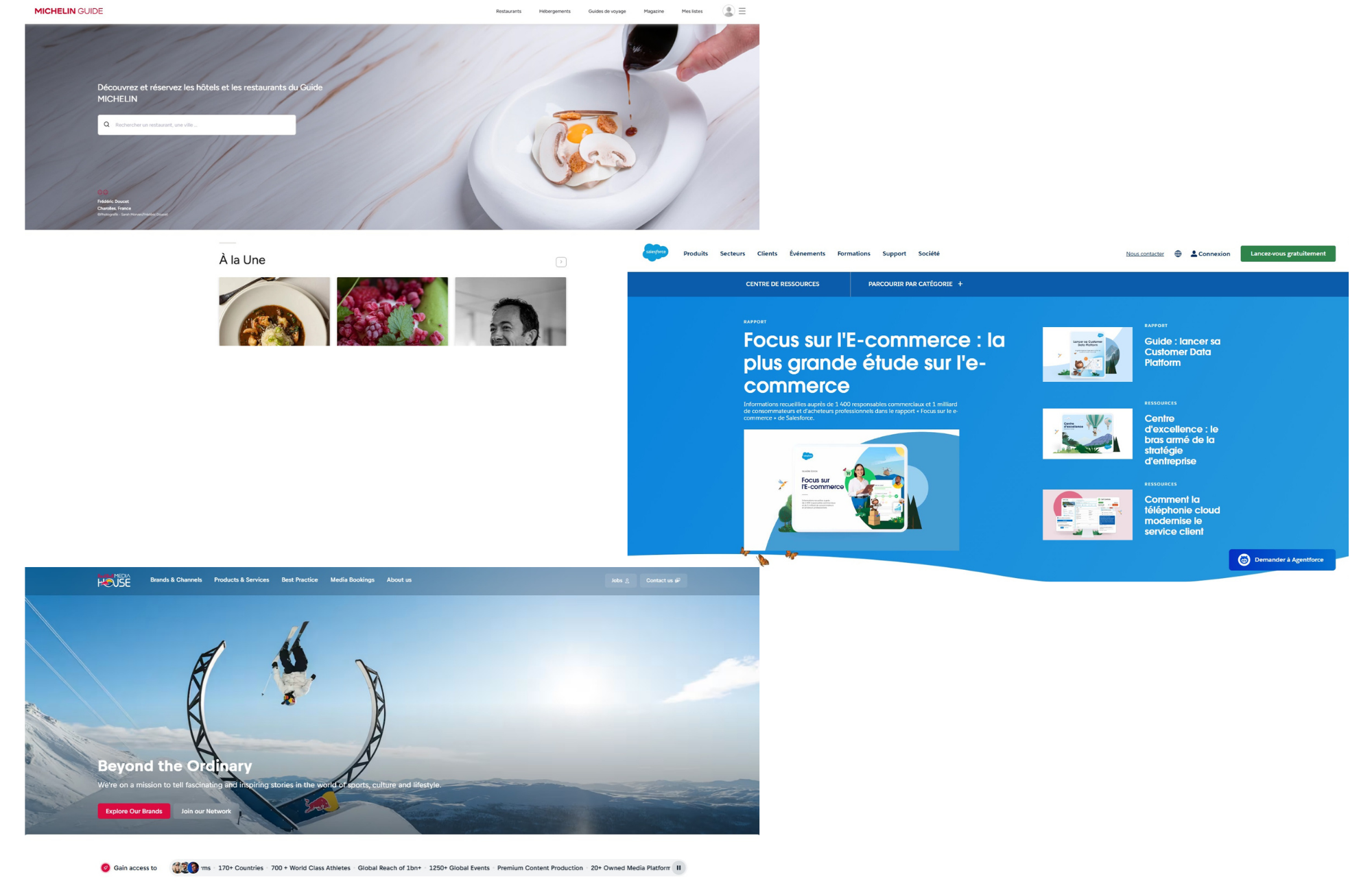
Michelin and its guides: the canonical example of brand content. A tire manufacturer creates a culinary and travel guide to encourage motorists to drive more miles and therefore wear out more tires. The Michelin Guide has existed since 1900: this is proof that brand content builds long-lasting assets.

Salesforce and its resource hub: Salesforce produces free guides, studies, webinars, and tools on everything related to customer relationships, CRM, and sales. The cost per lead is structurally lower than that of a pure paid campaign.

Red Bull and its media: Red Bull has built an editorial empire (Red Bull Media House) that produces documentaries, sports events, and digital content on a global scale. The brand is never highlighted as a product; it is associated with the values of pushing one's limits and adrenaline.

Checklist to launch your brand content strategy

Here are the 7 steps to validate before producing your first piece of content.

Clarify the brand platform. What is your mission? Your positioning? Your values? Your editorial personality? Brand content cannot work without a clear foundation.
Define the primary objective. Awareness? Lead generation? Loyalty? SEO authority? Each objective implies different formats, channels, and KPIs.
Identify your audience and their questions. Use Google Search Console, Semrush data, industry forums, and customer conversations to identify topics with real demand.
Choose 2 to 3 priority formats. It is better to excel at 2 formats than to produce mediocre content across 6 different channels. Start with formats you can sustain over time.
Define a realistic publication pace. Consistency matters more than frequency. One long-form article per month published over 18 months will yield better results than one article per week for 3 months, followed by nothing.
Structure content for AI. For each article: a summary at the beginning, a structured FAQ at the end, sourced and dated data within the body, and schema.org FAQPage markup.
Set up tracking. UTMs on all links, Google Analytics events (scroll, download, outbound click, video play), and assisted conversion tracking, not just last click.

How to measure brand content?

In the short term (1 to 3 months): organic traffic per article, engagement rate (time spent, bounce rate, scroll depth), social shares, newsletter subscriptions generated.

In the medium term (3 to 9 months): progression of SEO rankings on target keywords, overall organic traffic growth, organic traffic / paid traffic ratio, backlinks acquired.

In the long term (9 to 18 months): organic cost per lead vs paid cost per lead, assisted conversions generated by the content, growth in brand searches, citations in AI answers.

>>> Distribute your brand content on the right channels via Adintime

Summary table: brand content formats and their uses

Format Primary objective ROI (horizon) Target profile
📝 Long-form article (2,000+ words) SEO, authority, leads Long term (6-18 months) B2B, e-commerce, services
🎥 Short video (<3 min) Awareness, engagement Short term (1-3 months) B2C, social networks
📊 Proprietary study / data Authority, AI citations, backlinks Medium term (3-9 months) B2B, high-expertise sectors
✉️ Newsletter Loyalty, retention ROI 3,600 % (Long term) All sectors
🎙️ Webinar / podcast Qualified lead generation Medium term B2B, professional services
👥 UGC / employee advocacy Trust, engagement Short / Medium B2C, strong community brands

Brand content is not a replacement for advertising

This is perhaps the most costly confusion. Companies that cut their advertising budget to exclusively finance brand content take a real risk: brand content takes time to produce its effects, and during the transition period, visibility can drop.

The right strategy is not brand content against advertising, but brand content plus advertising—a mix that uses advertising for short-term traction and brand content to build a long-lasting editorial asset. This logic of a cross-channel strategy is at the core of the most high-performing setups. WARC research confirms that this mix improves total ROI by 25% to 100% compared to a single-channel approach.

For advertisers just starting out: start small. One well-built long-form article per month for 12 months, distributed via newsletter and social networks. Measure the progression of organic traffic, generated leads, and brand searches. At 12 months, you will have a data baseline to decide if and how to accelerate.

>>> Looking to distribute your brand content? Contact us directly

>>> Interested in our display offers? Click here

FAQ: Everything you need to know about brand content

What is brand content?

Brand content (or branded content) is a set of editorial-looking messages produced by an organization for communication purposes. Unlike traditional advertising that interrupts, brand content brings informational, educational, or entertaining value that the audience chooses to consume. It stands out due to its indirect approach: the brand builds preference through the value of its content, not through the repetition of a product message.

What is the difference between brand content and content marketing?

Content marketing is the overall strategy that encompasses the creation, distribution, and measurement of any content for marketing purposes. Brand content is a type of content produced within this strategy, centered on the brand's universe and values. You can do content marketing without brand content (SEO product sheets, for example), but effective brand content is part of a content marketing strategy.

What is the ROI of brand content?

Brand content generates leads 4.1 times cheaper than paid advertising after 12 months of regular production (Big Neurons, 2026). The crossover point with paid CPL occurs at a median of 7.3 months. Content marketing generates an average of 7.65 dollars in return for every dollar invested, while costing 62% less than traditional marketing and generating 3 times more leads.

Which brand content formats work best?

In 2026, the highest-performing formats are: long-form articles of 2,000+ words (2.8 times more leads per 1,000 visitors), short video (21% of marketers cite it as the format offering the best ROI), proprietary studies and data (high potential for AI citations and backlinks), and newsletters (ROI of 3,600%). The right format depends above all on the organization's objective and production capacity.

How to measure the effectiveness of brand content?

Indicators vary depending on the timeline. In the short term: traffic, engagement, newsletter subscriptions. In the medium term: SEO rankings, organic/paid traffic ratio, backlinks. In the long term: organic vs paid cost per lead, assisted conversions, brand search growth, citations in AI answers. Use multi-touch attribution rather than last click, as brand content often comes early in the buying journey.

Can brand content replace advertising?

No. Brand content and advertising operate under different temporal logics. Advertising works quickly but stops when the budget stops. Brand content works slowly but produces long-lasting effects. The optimal mix, according to WARC research, combines both: advertising ensures short-term traction, while brand content builds a sustainable editorial asset. A well-calibrated mix improves total ROI by 25% to 100% compared to an exclusively performance-driven strategy.

Related products

Related posts