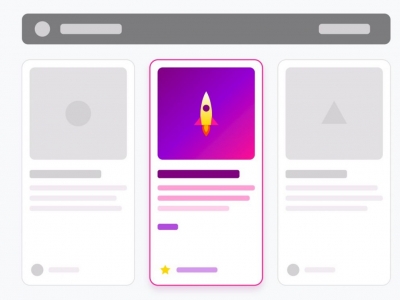
The specifications fit into four lines:
- a 1:1 image or a 256 × 256 px favicon
- a headline of 50 characters maximum
- a description of 100 characters maximum
- a destination URL with a customizable call-to-action
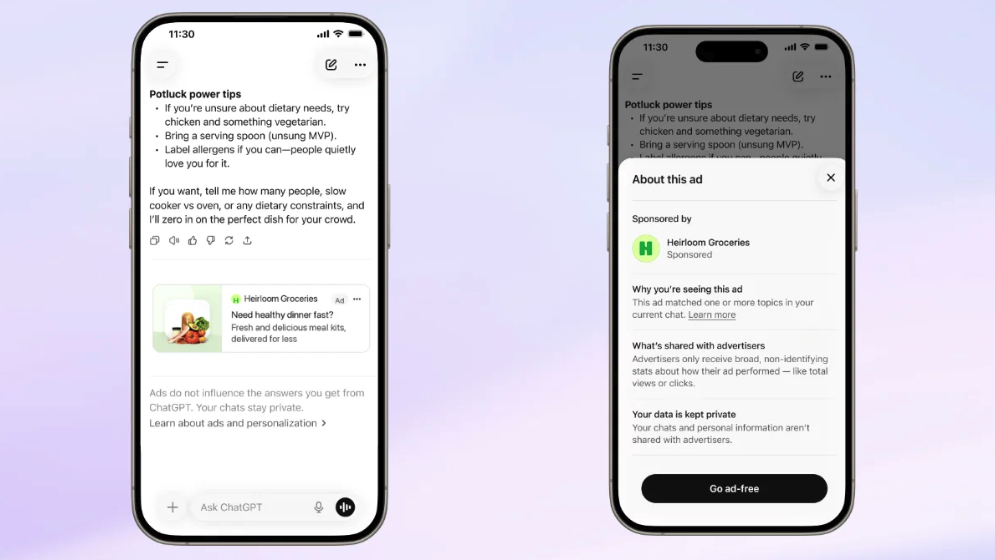
Fifty characters is not a lot. Keep in mind that the ad placement appears right after a response the user has just received. If it is written like a traditional ad copy, it risks breaking the conversational flow. If it is written as a natural extension of the answer, it expands on it and seamlessly integrates into the discussion.
Think of your ad message as if it were the next sentence in the conversation, rather than an interruption.
Context hints are not keywords
This is where most SEA teams end up pulling their hair out!
There is no keyword list, no exact match, no volume estimates, no negative keywords. Instead, there is an open text field at the ad group level called "context hints." In this space, you naturally describe the conversations, needs, situations, or pain points for which your offer is relevant.
OpenAI explains in its help documentation that these are directional signals for the system, not strict targeting rules. They do not guarantee impressions on any specific query. The system matches these inputs against the real-time context of the conversation, your headline, your copy, and your landing page.
The difference with Search is that in Search you buy "fast iphone charger." When writing hints, however, you write "someone complaining that their phone takes hours to charge and looking for which cable to buy."
Also, moderate your volume! Advertisers typically use around 5 to 15 hints per group. Below that, you miss eligible conversations. Above that, the theme dilutes, and the system loses track of your intent.
As for priority, move from narrow to broad: precise use cases first, expressed problems second, competitor comparisons last.
And above all: launch multiple groups with distinct hints from day one. Remember, this is a new platform—you need to run test & learn strategies! A documented test across three ad groups yielded click-through rates of 0%, 1.15%, and 2.4% depending on targeting. Same product, same budget, same creative. Three completely unrelated results.
Structure your account by moment, not by category
The habit we all have: a "Category A" group, a "Category B" group, a "Summer Sale" group. It's clean, it's logical, but on ChatGPT Ads, it is completely off the mark.
On Google, you optimize for a search query. On ChatGPT Ads, you optimize for a conversation. And a conversation doesn't depend on the product—it depends on where the user is in their decision-making process.
Take a CRM provider. Three conversations coexist at all times:
- someone who is just realizing that tracking sales on a spreadsheet is no longer sustainable
- someone who has been comparing three solutions for three weeks and can't decide
- someone who wants to switch tools right now and is looking for the migration process
Same product, same landing page. But three different vocabularies, three objection levels, and three distinct ads.
A simple test to validate your structure: take two hints from two different groups and ask yourself if the exact same ad copy would make sense in both cases. If yes, your groups should be merged. If no, your segmentation holds up.
Available reporting metrics are limited to seven fields:
- impressions
- clicks
- spend
- CTR
- average CPC
- average CPM
- conversions
Your account structure thus becomes your primary analytical tool. The granular it is, the better you will understand what works. This logic applies to any well-built cross-channel strategy: plan granularity dictates analytical clarity.
Set up your measurement systems before spending
As with any ad campaign launch:
« Do not launch anything until measurement is fully in place! »
This is the most profitable piece of advice in this article.
The OpenAI pixel first. A browser script that captures a click ID called oppref, passed in the destination URL, and stores it in a first-party cookie. If this ID gets dropped between landing and conversion (misconfigured redirect, internal navigation overwriting parameters), attribution breaks. This is the leading cause of documented under-attribution since launch.
The Conversions API second, for server-side event transmission. OpenAI explicitly states that CAPI is more reliable than the pixel alone and recommends implementing it as soon as possible. Since August 2026, Automatic Advanced Matching has been enabled by default on new web pixels: it uses hashed customer data to recover conversions that lost cookies would otherwise hide.
UTMs finally, on every single ad group without exception. Without them, your ChatGPT traffic lands as "Direct" in GA4 and becomes invisible. It is the same dark traffic phenomenon observed with generative search engines in organic, except here you are paying for every click.
Objectives, bidding, and what a click really costs
Ads Manager is organized into three levels:
- the campaign: budget, schedule, and geography
- the ad group: context hints and max bid
- the ad: headline, copy, image, and landing page
Three campaign objectives are available:
- CPM (Reach)
- CPC (Clicks)
- oCPC (Conversions)
Our recommendation: start with CPC, allow the pixel to accumulate clean event data, then create a Conversions campaign using oCPC. The platform displays a bid competitiveness indicator showing whether your bid risks limiting reach. Use it to calibrate—it is better than any rule of thumb.
On the cost side, benchmarks remain unstable with no official standard. However, here are a few estimates:
| Metric | Observed Value | Source |
|---|
| Average platform CTR | 0.68% (median 0.50%, upper quartile 1%) | Similarweb, 2026 |
| CTR on independent tests | 0.65% to 1.3% | SE Ranking, Choice OMG, 2026 |
| Google Search ad CTR (comparison) | around 6.4% | eMarketer, 2026 |
| Recommended starting CPC bid | $3 to $5 | OpenAI, 2026 |
| Actual observed CPCs | $1.72 to $8; $8 to $18 on SaaS and finance | Advertiser reports, 2026 |
| CPM | $60 at launch, $25 to $45 thereafter | Digiday, Ad Age, 2026 |
| Minimum daily budget | $25 | OpenAI, self-serve beta 2026 |
On paper, a CTR seven times lower than Google Search looks like underperformance. In practice, the comparison makes little sense: a Google results page shows multiple ads, while a ChatGPT conversation shows only one. A lower CTR is mechanically expected.
The metric requiring closer attention is post-click conversion rate. Case data published by agency Opascope shows a 2.35% conversion rate and a 1.49 blended ROAS over 15 days of activity. Other analyses report significantly higher rates in high-intent verticals. While none of these figures establish a standard, they point in the same direction: clicks are expensive and rare, but they arrive more qualified than elsewhere.
Who does this channel work for today?
Documented use cases are predominantly e-commerce and consumer-facing. Categories with high average order value and short decision cycles perform naturally well.
B2B and high-end sectors are less documented, though that doesn't mean they don't work. The few published reports on B2B SaaS are quite positive, with CTRs around 2.6% reported on select campaigns. Simply put, no one can currently guarantee performance in these segments backed by extensive data.
« Our advice at Adintime: treat ChatGPT Ads as an experimental budget »
The entry barrier is low: at $25 per day, it is a great opportunity to run a structured 4-to-6-week test.
Another factor to consider: this channel is still young, competitive bidding pressure remains low across most French market categories, and the expertise gained now in writing hints cannot be bought later.
Summary table
| Element | ChatGPT Ads | Search habit to abandon |
|---|
| Targeting unit | Natural language context hints | Keyword lists and match types |
| Organizational unit | The decision-making moment | Product category |
| Placements per query | Single placement awarded by relevance | Multiple SERP positions |
| User targeting (Europe) | Context, language, coarse location | Audiences, remarketing, user history |
| Reporting | 7 fields, no placement level view | Granular network and device breakdown |
| Performance assessment | Blended, over multiple weeks | Daily last-click |
| Creative | 50-character headline, conversational tone | Ad hook, marketing promise |
Where to start step-by-step?
A rollout sequence that avoids the most expensive mistakes:
- Create your advertiser account on ads.openai.com, complete business verification, and add a payment method.
- Install the pixel and Conversions API. Verify in debug mode that the oppref ID persists through your conversion funnel.
- Set up UTMs per ad group before creating any campaign assets.
- Define three to five conversation moments, allocating one per ad group.
- Write 5 to 15 hints per group, ranging from specific use cases to competitive comparisons.
- Launch with Clicks as the objective, using two or three creative variations per group.
- Run without adjustments throughout the testing window, then pause underperforming groups.
- Switch to a Conversions campaign using oCPC once the pixel reports reliable event data.
FAQ: Everything you need to know about ChatGPT Ads
Is ChatGPT Ads available in France?
Yes. Ads have been running in France since August 24, 2026, as part of an expansion to 31 European markets. Self-serve access via Ads Manager opened in beta on August 31, 2026, for eligible advertisers: account setup, business verification, and payment registration on ads.openai.com.
Who sees ads on ChatGPT?
Only adult users on Free and Go plans (the entry-level subscription at €8 per month). Plus, Pro, Business, Enterprise, and Edu subscriptions remain ad-free. Free users can also opt for an ad-free experience in exchange for reduced usage limits.
How much does a ChatGPT Ads campaign cost?
There is no minimum commitment requirement, and the observed minimum daily budget is $25. OpenAI recommends a starting bid of $3 to $5 per click. Actual observed CPCs range from $1.72 to $8 depending on vertical, reaching $8 to $18 in SaaS, finance, and legal services. CPMs, which started at $60 during the US launch, average between $25 and $45 in 2026.
What is a context hint?
A context hint is a natural language description entered at the ad group level, outlining conversations, needs, or situations where your offer is relevant. It is not a keyword: there are no exact match types, volume estimates, or negative keywords. OpenAI describes it as a signal provided to the system, which cross-references it with real-time conversation context, your creative, and your landing page.
Why does my ChatGPT Ads dashboard show more clicks than my analytics counts as sessions?
Multiple factors contribute to this. Attribution methodologies differ between Ads Manager and GA4, as OpenAI acknowledges in its documentation. The oppref click ID can get dropped along the conversion path, breaking tracking. Finally, without UTM parameters, traffic lands as "Direct" in analytics. One advertiser reported 120 dashboard clicks for only 8 recorded sessions. The solution: set UTMs per group, install the pixel alongside CAPI before spending, and analyze performance on a blended basis rather than last-click.
What CTR can be expected on ChatGPT Ads?
Independent metrics place average CTR between 0.65% and 1.3%, with a median around 0.50% and an upper quartile above 1% (Similarweb, 2026). Top-performing documented campaigns reach 2.4% to 5.4%. The gap compared to Google Search ads (around 6.4%) is structural: a single conversation shows only one ad placement, whereas search result pages show multiple.
Do I need an agency to launch ChatGPT Ads campaigns?
No, not since August 31, 2026. Four access routes coexist: self-serve via Ads Manager, agency partners, tech partners, and direct OpenAI sales teams. Self-serve access remains subject to business verification and OpenAI advertising policies.
Does ChatGPT Ads replace Google Ads?
No, and not in the short term. Inventory is restricted to Free and Go plans, there is only one placement per conversation, and 95% of ChatGPT users also use Google over the same period. The two platforms complement rather than replace each other. Treat ChatGPT Ads as a complementary test channel in your marketing mix, not as a replacement.



 Top 30 best ad musics of all time (Updated 2026)
 The influence of advertising on purchasing behavior
 What is commercial advertising?
 Top 5 colors to use for creating your advertising posters | Adintime
 Facebook Ads Library: The ultimate guide to winning campaigns
 The AIDA model in advertising : Definition and examples
 First-party data : Definition and challenges in the cookieless era
 Customer Acquisition Cost (CAC) : Calculation and optimization
 ChatGPT Ads: How to set up your first campaign in France ?
 Pink October : communicating effectively and avoiding pinkwashing