New ! Find your advertising panels at a glance  DISCOVER

Native Advertising : What is it and how does it differ from display advertising?

Pôle Marketing

Want to save time ?

Get this article summarized in seconds with AI

Résumé de l'article : Native advertising

💡 La publicité qui se fond dans le contenu

  • Le native advertising désigne des formats publicitaires payants qui imitent le style et l'ergonomie du média où ils apparaissent : articles sponsorisés, in-feed ads, widgets de recommandation, vidéos in-article
  • C'est l'un des segments les plus dynamiques de la publicité digitale, porté par la saturation du display classique, la hausse des ad-blockers et la migration vers le mobile
  • Les formats natifs obtiennent des CTR 2 à 5 fois supérieurs aux bannières display dans les mêmes environnements, et résistent mieux aux bloqueurs de publicité

📊 Native vs display vs brand content : trois logiques distinctes

  • Le display est visible en périphérie du contenu, le native s'intègre dans le flux de lecture, le brand content est produit par la marque elle-même sans forcément être acheté comme espace
  • Le native est une forme de distribution payante : on peut acheter de l'espace pour diffuser du brand content, mais les deux concepts ne se confondent pas
  • La distinction est importante pour les annonceurs, car budget display et budget native répondent à des objectifs et des métriques différents

🎯 Les plateformes à connaître en France

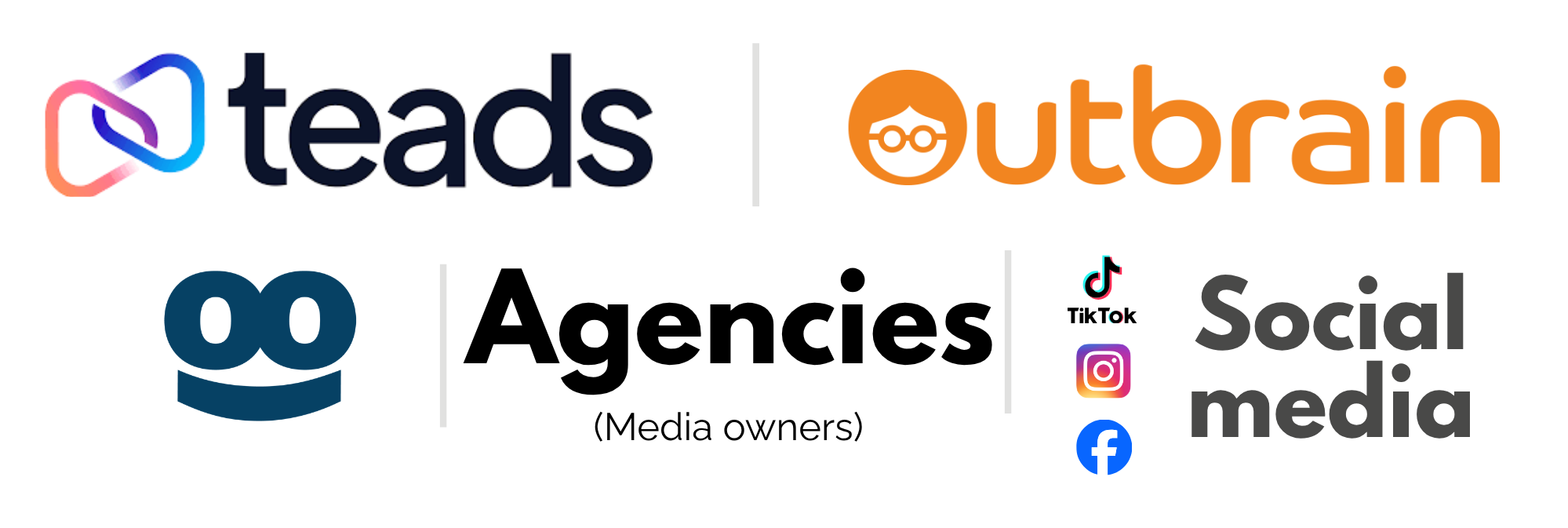
  • Taboola et Outbrain dominent les widgets de recommandation (content discovery) en CPC sur la presse française
  • Teads s'est imposé sur la vidéo native in-article auprès des grands médias français
  • Les régies propriétaires des médias (Le Monde, Figaro, Prisma...) proposent leurs propres offres natives premium pour des opérations plus qualitatives

The banner ad is over 30 years old. And it shows. Click-through rates on classic display formats hover around 0.05 to 0.1% across many inventories. Ad-blockers are installed on a significant portion of desktop browsers in France. Internet users have developed what neuropsychologists call "banner blindness": the brain learns to ignore the peripheral areas of content.

Native advertising was born from this observation. Rather than placing the advertisement next to the content, it integrates it directly into the reading feed, adopting the style and layout of the media platform. The result: formats that are more visible, harder to bypass, and often more engaging, provided they are well executed.

This guide explains precisely what native advertising is, how to distinguish it from display and brand content, what formats are available, which platforms operate in France, and how to integrate it into a media strategy.

Article table of contents

  1. Precise definition of native advertising
  2. Native vs display vs brand content: the real differences
  3. Native advertising formats
  4. Platforms in France
  5. Engagement and ad-blockers: the numbers
  6. Concrete examples by sector
  7. How to choose your format
  8. Comparative table
  9. FAQ

Precise definition of native advertising

Native advertising is a paid advertising format that matches the look, tone, and user experience of the media platform or feed in which it appears. The core idea is that the advertisement does not intrude, it integrates.

Two criteria define a native format. First, it looks like the content surrounding it: same layout, same typography, same structure. Second, it must be clearly identified as an advertisement: the label "Sponsored", "Ad", or "Recommended by" is mandatory in France, otherwise it falls into undeclared advertorial, which ARPP regulations strictly prohibit.

The term is broad. A sponsored article hosted on Le Monde's website that adopts the newspaper's editorial design, a sponsored post slipping into a Facebook newsfeed, a "You might also like" widget at the bottom of a news article blending editorial links and advertiser links: all of these fall under native advertising.

>>> What is an advertorial?

Native vs display vs brand content: the real differences

These three concepts are often confused in advertiser briefs. The confusion is understandable because the boundaries overlap. However, the underlying logics are different:

1. 🖥️ Display 2. 📰 Native advertising 3. ✨ Brand content

Visible on the periphery of content (header, sidebar, space between two paragraphs). It does not claim to be part of the editorial content.

Its effectiveness relies on repetition and reach.

Limitations: The eye has learned to ignore it (banner blindness) and ad-blockers target it as a priority. Its dominant form, programmatic bought via RTB, offers fine targeting but suffers from the same obstacles.

Integrates directly into the feed and adopts the form of the surrounding content. It is paid and clearly labeled.

Its effectiveness relies on contextual relevance and engagement.

Limitations: If it looks too much like editorial content without being clearly labeled, it crosses into deception territory and harms trust.

Content produced by or for a brand, providing informational, educational, or entertainment value. It can exist without ad space buys (e.g., a post on the brand's blog).

Native advertising is often the distribution channel for brand content: ad space is bought on native platforms to amplify its reach.

In practice: Producing a guide on "How to choose home insurance" is brand content. Amplifying it via Taboola or Outbrain means using native advertising.

>>> Discover display offers available on Adintime

>>> This is how programmatic display advertising works

Native advertising formats

  • Sponsored articles (native editorial)

An article, feature story, or report co-produced with the host media outlet, hosted on that media's website, and written in its editorial style. This is the highest-quality and most expensive native format: production is collaborative, the URL belongs to the media platform, and the reading experience is identical to that of an editorial piece. Typical use case: explaining a complex product (insurance, credit, SaaS) or telling a brand story within a credible context.

  • In-feed native ads

Advertisements inserted directly into a content feed: article lists, editorial carousels, or news feeds. The format replicates the editorial layout of the feed (image + title + teaser + advertiser logo). This is the model used by Taboola, Outbrain, and social media platforms for their sponsored posts. The CTR is generally better than banners because the format aligns naturally with the user's continuous scrolling gesture.

  • Recommendation widgets (content discovery)

The "You might also like" or "Recommended by" blocks found at the bottom of articles, which mix links to other pages on the site with sponsored links from advertisers. Taboola and Outbrain are the global leaders in this segment. The model is typically based on CPC. The advertiser's objective: drive qualified traffic to a piece of content or a dedicated landing page.

  • In-article native video (in-read)

A video that autoplays (or plays upon clicking) within the body of an article without interrupting the user's reading. Teads built its business model on this format. The reader can keep scrolling while the video remains visible within their field of view. The completion rate is generally higher than classic pre-roll video because the format is much less intrusive.

Platforms in France

Taboola is the global leader in native content discovery. In France, it operates across a wide network of media outlets (general press, news, lifestyle, celebrity news). The model is CPC-based, featuring a self-service interface that allows advertisers to get started with limited budgets. Its recommendation widgets are present on almost all major French publications.

Outbrain is the direct competitor to Taboola in the content discovery segment. It acquired Ligatus, a former major player in European native advertising, which strengthened its footprint on French inventory. While both platforms function similarly, their media coverage varies: depending on the target site, one platform will be available while the other is not.

Teads has established itself as the leader in in-article native video, particularly within the French economic, cultural, and lifestyle press. Its premium distribution model (CPM, purchased via agencies or trading desks) is geared toward advertisers with brand awareness budgets rather than VSEs using self-service platforms.

Media owners' in-house sales houses (M6 Publicité, Le Monde Publicité, Figaro Médias, Prisma Media Solutions...) offer their own native solutions, either directly or through custom packages. These campaigns are generally higher quality and more expensive than automated content discovery, but they provide a more precise editorial context and a stronger affinity with the publication's audience.

Mention must also be made of social media platforms, notably Meta and TikTok. Sponsored posts in a Facebook or Instagram feed, or sponsored videos in a TikTok feed, technically fit the definition of native advertising: they adopt the format of organic content. In practice, social ads budgets and native budgets are often handled separately, but the logic of contextual targeting applies to both. To learn more about social media formats, browse our dedicated offers.

>>> Learn more about sales houses

Engagement and ad-blockers: what the data shows

Native advertising holds an advantage over classic display on two main fronts:

  • Engagement: Industry benchmarks estimate native format CTRs at between 0.3% and 1% depending on the context, compared to 0.05% to 0.1% for classic display banners. This represents a 2 to 5-fold increase in favor of native, with strong variability depending on the sector, creative asset, and targeting. Time spent on a well-written sponsored article is also significantly higher than the time generated by a banner click.
  • Ad-blockers: Classic display banners (rectangles, skyscrapers, standard IAB formats) are the primary targets of ad-blockers. Native formats integrated into articles hosted by media sites, or within mobile apps, are harder to block: they are part of the editorial DOM rather than an external call to an ad server. While recommendation widgets can be partially blocked by more advanced ad-blockers, their viewability rate remains, on average, better than that of equivalent banners.

This does not mean that native advertising is without its limitations. A poorly written or overly promotional sponsored article will destroy user trust in the media outlet. A recommendation widget with a clickbait headline might drive traffic, but it will result in high bounce rates and low value. Creative quality remains the primary determinant of performance.

Concrete examples by sector

Banking and insurance

Explaining a complex product (home insurance, retirement savings) through a sponsored article on a general audience media outlet. Distribution via Taboola/Outbrain widgets to reach qualified readers, followed by display or social retargeting of the article's visitors. This is one of the most common uses of native advertising for financial services.

Automotive

In-article video via Teads placed within car reviews or mobility features in the specialized press. This format showcases the vehicle in motion within a relevant editorial context, avoiding the intrusiveness of pre-roll ads. It is often complemented by "long-term test drive" sponsored articles co-produced with the media platform.

Tourism and leisure

An advertorial titled "A perfect weekend in Marseille" hosted on a lifestyle media site, amplified via content discovery (Taboola, Outbrain) targeting "travel" audiences. The article inspires readers, drives time spent on the page, and creates a positive association between the destination and the brand.

Retail and e-commerce

In-feed native ads on news or fashion websites linking to shopping guides. Here, native advertising serves as a mid-funnel acquisition channel: the reader is not yet in a purchasing mindset, but the content guides them to discover an offer within a relevant context.

B2B and tech

A sponsored article titled "How to optimize your recruitment process in 2026" on an HR or business publication, linking to a white paper or a product demo. Native advertising allows B2B companies to reach decision-makers while they are in a reading and reflection mindset, rather than within a saturated search environment.

How to choose your format?

The choice of format depends primarily on your objective. If you are looking to drive qualified traffic to a piece of content or a landing page with a controlled budget and quick setup, content discovery widgets (Taboola, Outbrain) offer an accessible entry point. If you aim to associate your brand with a specific editorial context and high perceived value, a direct sponsored article with a media outlet is more appropriate, even though it comes at a higher cost.

Next comes the matter of content. Native advertising only amplifies what is genuinely worth reading. A weak, overly promotional article, or one that fails to deliver on its headline's promise, will result in high bounce rates and ruin performance. The editorial quality of the content is at least as important as the targeting.

To integrate native advertising into a coherent cross-channel strategy , it typically occupies the mid-funnel: it nurtures consideration and preference after the awareness phase (TV, OOH, social) and before conversion (search, retargeting). It is a content format with high sharing potential and strong ad recall, provided that the content delivers on its value.

>>> Discover our offers for out-of-home advertising, TV advertising, and social media

Comparative table: native, display, brand content

Criterion 📰 Native advertising 🖥️ Classic display ✨ Brand content
Positioning Integrated into the content feed On the periphery of the content Published on the brand's or media's own channels
Format type Sponsored article, in-feed ad, widget, in-article video Banner, rectangle, skyscraper, site skin Blog post, video, podcast, guide
Ad labeling Mandatory ("Sponsored") Visible (standardized format) Variable depending on context
Average CTR 0.3 to 1%
(depending on context)
0.05 to 0.1% Variable
(depends on distribution)
Ad-blocker resilience Good
(in-app, hosted by the media outlet)
Low
(targeted as a priority)
Very good
(organic content)
Funnel role Mid-funnel
(consideration, engagement)
Awareness, repetition, retargeting Long-term
(authority, SEO, preference)
Starting budget A few hundred €
(self-service)
Variable Production cost, no mandatory media buy

Native advertising is not a silver bullet

The format has its limits. A clickbait headline that fails to deliver on its promise generates traffic but no value. A poorly written sponsored article harms a brand's image as much as it benefits it. And certain content discovery formats, if poorly managed, can end up on low-quality inventory that tarnishes the advertiser's reputation.

Native is a content distribution format, not a magic wand. It performs well when the content is worth reading and when targeting is precise. Under these conditions, it is one of the most effective formats for driving brand consideration and preference at a reasonable cost.

>>> Submit your brief on Adintime for recommendations and launch your campaign

FAQ: Everything you need to know about native advertising

What is native advertising?

Native advertising is a paid advertising format that matches the style and user experience of the surrounding content: same layout, same typography, same structure. It must be identified as an advertisement (using labels like "Sponsored" or "Ad"). It includes sponsored articles hosted by media outlets, in-feed ads within content streams, recommendation widgets, and in-article videos.

What is the difference between native advertising and display?

Display is positioned on the periphery of the content (banners, rectangles, site skins) and is visually distinct from editorial content. Native integrates into the reading feed by adopting the style of the media outlet. As a result, native generally achieves CTRs 2 to 5 times higher than classic display and is more resilient to ad-blockers, particularly on mobile and within in-app environments.

What is the difference between native advertising and brand content?

Brand content is content produced by or for a brand (articles, videos, podcasts) that provides editorial value. It can exist without purchasing ad space. Native advertising is a form of paid distribution: you buy native spaces to amplify your brand content to a targeted audience. The two are complementary but should not be confused.

What are the main native advertising platforms in France?

Taboola and Outbrain (formerly including Ligatus) dominate content discovery widgets across the French press. Teads has established itself in in-article native video. The in-house sales houses of major media outlets (Le Monde, Figaro, Prisma...) offer premium native solutions directly. Social platforms (Meta, TikTok) also offer in-feed formats that technically meet the definition of native advertising.

What are the engagement rates for native advertising?

Industry benchmarks estimate the CTR of native formats to be between 0.3% and 1%, compared to 0.05% to 0.1% for classic display banners. These figures vary heavily depending on the sector, content quality, and targeting. Time spent on a well-executed sponsored article is also significantly higher than that generated by a banner click.

How do you integrate native advertising into a media strategy?

Native typically occupies the mid-funnel: it nurtures consideration after the awareness phase (TV, out-of-home, mass social) and before conversion (search, retargeting). It is particularly effective for explaining a complex product, sharing expertise, or associating a brand with a credible editorial context. It works best when the distributed content is high quality: poor or overly promotional articles generate high bounce rates and disappointment.

Related products

Related posts