New ! Find your advertising panels at a glance  DISCOVER

Cinema ads : formats, ad networks and rates to communicate on the big screen

Pôle Marketing

Want to save time ?

Get this article summarized in seconds with AI

Article summary: Cinema advertising

💡 What the market says in 2026

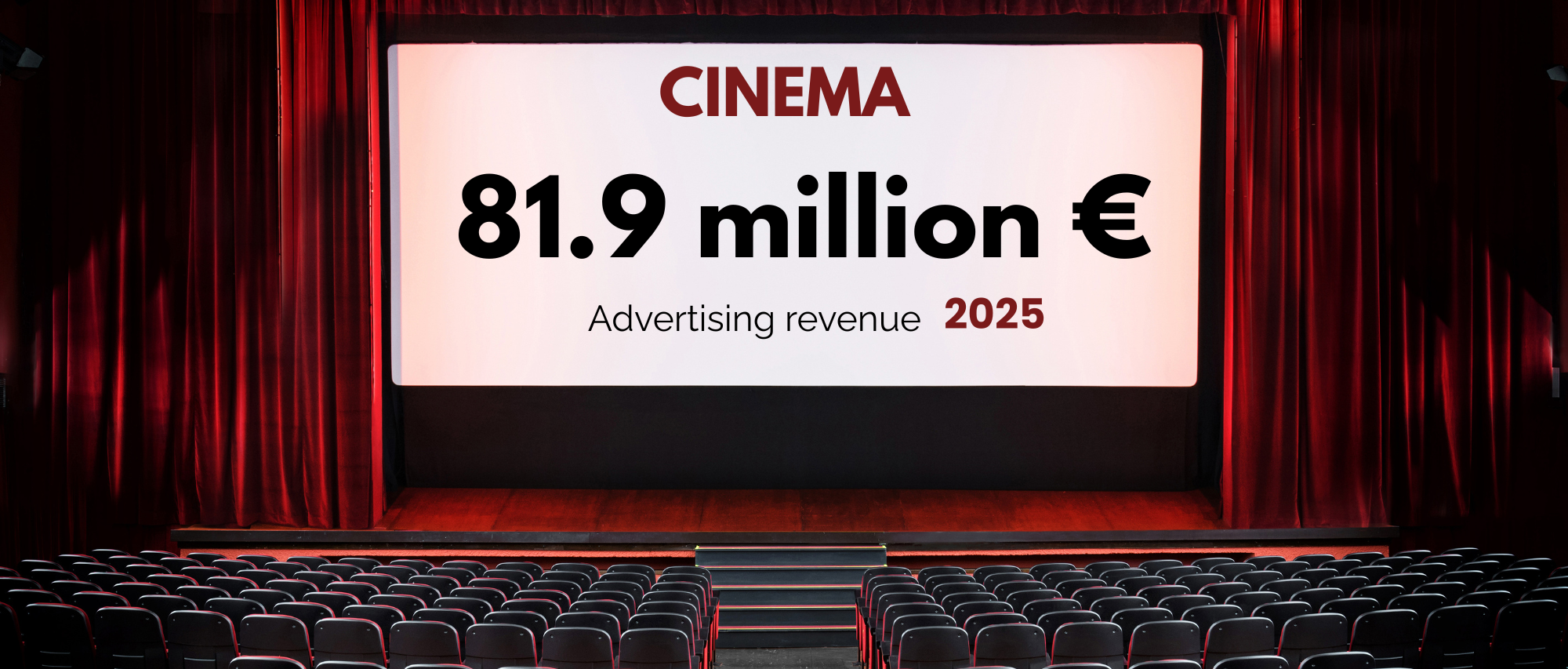
  • 81.9 million euros in net advertising revenue for cinema in 2025, +5.5% over one year (Kantar Media, 2025), the market is progressing despite a decline in admissions
  • Cinema attendance rebounded by +19% over the first 4 months of 2026 compared to 2025 (CNC, May 2026)
  • Médiavision, the leading ad network, represents 83% of the advertising inventory, 544 cinemas, 3,674 screens in France

📊 The upper-income advantage: a rare audience in the advertising landscape

  • 46% of cinema-goers are upper-income (vs 25.9% for the French population), the strongest affinity index of all mass media
  • Effective viewing duration for 30 seconds: 25 sec in cinema vs 17 sec on linear TV, 15 sec on AVOD, 14 sec on YouTube (Lumen/TVision, 2024)
  • 2/3 of moviegoers arrive early on purpose to see the trailers and commercials, a captive and receptive audience by definition

🎯 2026 Rates: from local to national

  • Local campaign in the provinces: 300 to 800 €/week, accessible to all SMEs and local businesses
  • Local campaign in Paris or in a large city: 1,000 to 1,500 €/week
  • National campaign via Médiavision: 40,000 € net minimum (entry-level), up to several hundred thousand euros for blockbusters

81.9 million euros in advertising revenue. This is what cinema generated as a media format in 2025, up 5.5% in a global advertising market that itself fell by 1.4% over the same period. While theater attendance fluctuated (157 million admissions in 2025, -13.6% compared to the record-breaking year of 2024), advertisers maintained and even increased their investments.

This is the paradox of cinema advertising: it is the smallest of the major media formats in terms of investment volume, but one of the most effective in terms of captured attention. A dark theater, an audience that came to watch, and no phone screens—it is a combination that no other medium can replicate.

This guide covers the available formats, the ad networks you need to know, the actual rates, and the cases where cinema advertising makes sense, or not.

Article summary

  1. The cinema advertising market in 2026
  2. The cinema audience: upper-income profile and captive attention
  3. Cinema advertising networks: who are the players?
  4. Cinema advertising formats
  5. 2026 Rates: from local to national
  6. The production of a cinema ad
  7. Why choose cinema: the real strengths of the medium?
  8. The limitations of cinema advertising
  9. Summary table
  10. FAQ

The cinema advertising market in 2026

Cinema is the smallest of the major media formats measured by the IREP: 81.9 million euros in net advertising revenue in 2025 as we said previously, which is less than 1% of the overall French advertising market. This is both its weakness and its distinctive feature. It does not compete with TV for mass reach, nor with digital for precise targeting. It occupies a very specific niche: high attention, high upper-income affinity, and physical captivity.

What is notable is the resilience of the medium. In 2025, cinema admissions fell by 13.6% compared to the record year of 2024. Despite this drop in audience, advertising revenue grew by 5.5%. In 2026, the rebound in attendance is confirmed: +19% over the first four months compared to the same period in 2025, with 62.73 million admissions between January and May (CNC, 2026).

288 active advertisers in 2025, compared to 336 in 2019 (-14%). Cinema advertising is a deliberate, targeted purchase, often linked to a qualitative awareness strategy rather than a volume-based plan.

The cinema audience: upper-income profile and captive attention

Out of the 143 million admissions recorded in France between January and October 2024, 66 million came from upper-income and top-income demographics, representing 46% of spectators, compared to 25.9% for the general population. The affinity index is 177: a cinema spectator is 77% more likely to be upper-income than the national average.

For luxury, banking, insurance, automotive, or premium technology brands, this argument is hard to ignore. Other major mass media do not allow for this level of upper-income concentration without extremely fine and costly targeting.

According to measurements from Lumen and TVision, for a 30-second spot, the effective viewing duration is 25 seconds in cinema, compared to 17 seconds on linear TV, 15 seconds on AVOD platforms, and 14 seconds on YouTube. This is not a matter of choice: the spectator is physically in the auditorium, with no way to zap away, in the dark, facing a screen that is several meters wide.

9.2 million French people go to the cinema at least once a month (17% of the population). And two-thirds of them deliberately arrive early to see the trailers and commercials.

Cinema advertising networks: who are the players?

Médiavision is the dominant ad network, with 83% market share. It operates more than 3,674 screens across 544 complexes throughout the country. Founded in 1971 and owned by BDC (52%), Jean Mineur (38%), and Publicis Groupe (10%), it is the main point of contact for any national cinema campaign. The entry point for a national campaign is around 40,000 euros net.

Canal+ Brand Solutions represents 13% of the market. The network commercializes the commercial screens of Pathé and Gaumont cinemas, a significant portion of large French movie theaters, particularly in the Île-de-France region.

Censier Publicinex and a few local ad networks complete the market, providing access to independent cinemas, often located in city centers, with an older and more cultured audience.

For SMEs and local authorities, regional agencies and independent theater operators provide access to local inventories at much more accessible rates.

Cinema advertising formats

The dominant format is the traditional spot (20 to 30 seconds) broadcast on the commercial screen before the film. 15-second formats exist for short messages, and formats up to 60 seconds are available for narrative content.

Special operations allow you to go further: sponsorship of a specific film (your spot broadcast only during the screenings of a targeted movie, chosen for its affinity with your brand), screen wrapping in lobbies, and interactive formats in certain equipped theaters.

The DCP (Digital Cinema Package) format is mandatory for theater broadcasting, a technical constraint that adds to the production cost.

2026 Rates: from local to national

2026 Cinema advertising rates

Broadcast scale Rates (2026) Specifics & Complements
At the local level 300 to 800 € / week
(1,000 to 1,500 € in Paris/Large cities)
Budgets indicated exclude ad production costs.
At the regional level 2,000 to 10,000 € / week The final amount varies precisely depending on the targeted geographical coverage.
At the national level 40,000 € net minimum Campaigns operated via Médiavision. A spot placed just before a blockbuster can mobilize several hundred thousand euros for major brands.
Production 3,000 to 20,000 €+ Count on 3,000 to 8,000 € for a simplified format, and 15,000 to 20,000 €+ for a custom-made big screen creation. Technical DCP encoding represents an additional cost of 300 to 800 € per version.

>>> Complementary to cinema for local visibility: discover outdoor advertising on Adintime

The production of a cinema ad: what you need to know

A spot designed for TV does not necessarily work well in cinema. On the big screen, every detail is amplified: insufficient image quality, poorly mixed sound, a message that is too busy—everything is seen and heard immediately.

Professionals recommend a simple and visual message. The image takes precedence over text on the big screen. Delivery in DCP requires precise specifications (2K or 4K resolution, bitrate, audio format). Technical DCP encoding represents an additional cost of 300 to 800 euros per version.

>>> The complete guide on how to do TV advertising

>>> Discover our TV advertising offers

Why choose cinema: the real strengths of the medium?

Captivity. Nowhere else do spectators watch a commercial without being able to avoid it. No remote control, no scrolling, no tab to open.

The emotional setting. Cinema is an outing, a chosen moment, an experience shared in a group. The spectator is in a positive and receptive emotional state. Studies measure a positive image transfer for the luxury and entertainment sectors.

Audio and visual quality. Nowhere else will your spot be broadcast on a 15-meter screen with Dolby sound. If your brand has invested in a high-quality production, cinema is the only medium that fully values this creative investment.

Contextual targeting. Buying space during the screenings of a specific film means buying an audience pre-qualified by its interest in the genre.

The limitations of cinema advertising

Reach is limited. 9.2 million monthly moviegoers, a structural ceiling. For a mass awareness campaign, TV or digital offer volumes that are inaccessible to cinema.

Programming is uncertain. If the movie showing during your campaign flops, the audience is lower than expected.

The production cycle is long. 4 to 8 weeks minimum from the decision to the broadcast. It is not a rapid activation medium.

Measurement is complex. Unlike digital, there is no direct attribution. Advertising recall studies offered by ad networks require a fee.

>>> Find all our social media offers to complete your communication plan

Summary table: cinema advertising 2026

Criterion Local cinema Regional cinema National cinema
Broadcast rate / week 300 – 1,500 € 2,000 – 10,000 € 40,000 €+ net
Spot production 3,000 – 8,000 € 8,000 – 20,000 € 15,000 – 80,000 €+
Ad network Local / independent Regional Médiavision / Canal+ Médiavision / Canal+ Brand Solutions
Standard spot duration 10 – 30 sec 20 – 30 sec 20 – 30 sec
Target profile Local SME, neighborhood business Mid-caps, regional chains Major brands, luxury, banking, auto
Strong point Accessibility, local roots Regional coverage + upper-income High attention, film contextual targeting

Cinema: a niche medium, not a mass medium

Cinema advertising has never been and will probably never be a volume-based medium comparable to TV or digital. This is a structural characteristic, not a problem to be solved. Cinema attracts spectators who have made an active effort to come to the theater, and this effort is precisely what makes their attention so valuable.

A local spot at 500 euros per week in a provincial cinema, seen by 2,000 to 5,000 spectators under conditions of maximum attention, can generate more memory impact than a display campaign with 10 times that budget.

The condition: having a spot that lives up to the medium. The big screen amplifies everything—the qualities of good content as well as the flaws of a poorly produced one.

>>> For more information about our offers, contact us directly and get a free quote

FAQ: Everything you need to know about cinema advertising

How much does a cinema advertisement cost?

The rate depends on the geographical level. At the local level (a provincial cinema), count on 300 to 800 euros per week of broadcasting, excluding production. In Paris or a large city: 1,000 to 1,500 euros per week. A national campaign via Médiavision starts at around 40,000 euros net. To be added: the production of the spot (3,000 to 20,000 € depending on the level) and the DCP encoding (300 to 800 €).

What advertising formats exist in cinema?

The classic spot (20-30 seconds) before the film is the norm. 15 and 60-second formats exist. Special operations include: sponsorship of a specific film, lobby wrapping, interactive formats. All spots must be delivered in DCP (Digital Cinema Package).

Which cinema advertising networks operate in France?

Médiavision (83% of the market, 544 cinemas, 3,674 screens), Canal+ Brand Solutions (13%, Pathé/Gaumont cinemas), and Censier Publicinex for independent theaters. Local ad networks provide access to regional circuits at lower rates.

Who are the cinema spectators?

46% are upper-income (vs 25.9% French pop). 9.2 million French people go to the cinema at least once a month. Effective viewing duration: 25 sec out of 30 (vs 17 sec on TV). 2/3 arrive early for the advertisements.

Is cinema advertising suitable for SMEs?

Yes, at the local level: 300 to 800 €/week in the provinces. The condition is to invest in a production suitable for the big screen, a minimum of 3,000 to 5,000 € for a functional spot in theaters.

Which sectors invest the most in cinema advertising?

Culture & Leisure (43% of gross revenues), Banking-Insurance and Automotive (increasing), Luxury. Sectors that avoid cinema: consumer goods, direct-response promotions—cinema is not a volume-based medium.

Related products

Related posts