New ! Find your advertising panels at a glance  DISCOVER

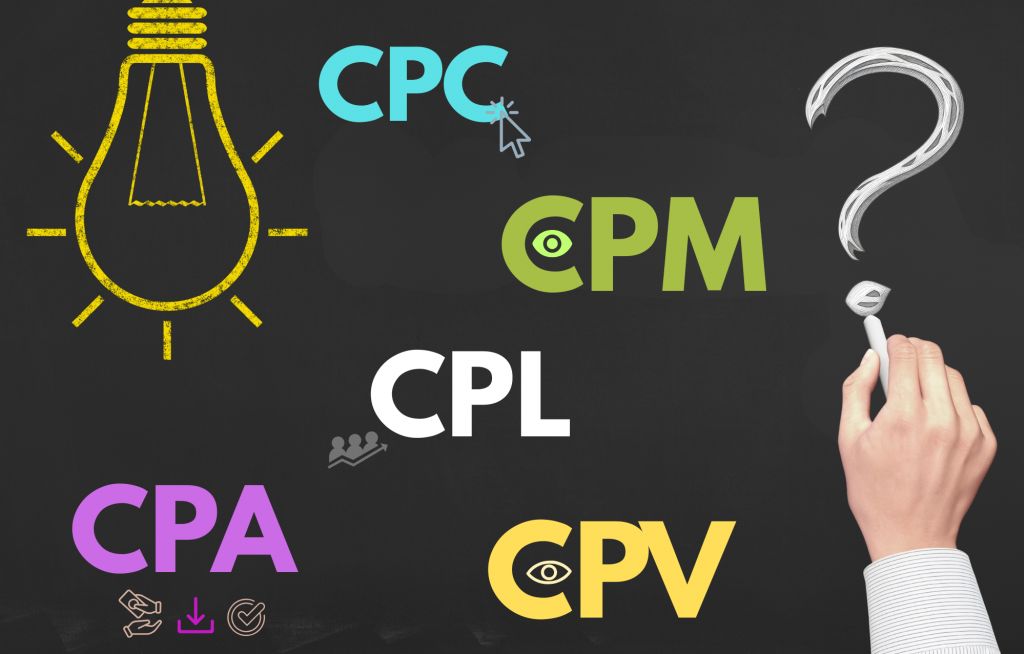
CPM, CPC, CPA, CPV : Which advertising purchasing model to choose ?

Pôle Marketing

Article summary : Advertising billing models

💡 What you pay for depending on the model

  • CPM: you pay to be seen (per thousand impressions). CPC: you pay per click. CPA: you pay per completed action.
  • CPV: you pay per video view. CPL: you pay per generated lead.
  • No model is inherently better than another: it all depends on your campaign objective.

📊 Cost benchmarks in France 2026

  • CPM: from €3 to €8 in display and programmatic, €8 on Meta, up to €45 on LinkedIn.
  • CPC: around €1.80 on Google Search, €0.20 to €0.80 on Meta, €3 to €8 on LinkedIn.
  • YouTube CPV: €0.02 to €0.10 per view.

🎯 Which model for which objective?

  • Brand awareness: CPM; Traffic: CPC; Conversion: CPA; Video views: CPV; Leads: CPL.
  • The model shifts more or less risk from you to the ad network.
  • The right approach: choose the model that matches the indicator you want to manage.

When you buy advertising, you don't always pay for the same thing. Sometimes for the display, sometimes for the click, sometimes for the sale. This choice is the billing model, and it changes everything: your budget, your risk level, and how you judge the campaign.

Choosing the wrong model means paying for an objective that is not yours. Paying per click when you want brand awareness, or per thousand impressions when you want sales, complicates your life and distorts your interpretation of the results.

We will review each model, what you pay for, its advantages, its limitations, its real costs in France, and how to choose according to your objective. For a detailed definition of the cost per thousand impressions, our dedicated article on CPM goes deeper; here, we focus on the choice.

Article summary

  1. CPM: paying to be seen
  2. CPC: paying per click
  3. CPA: paying per action
  4. CPV: paying per video view
  5. CPL: paying per lead
  6. Which model to choose according to your objective ?
  7. The real question: who carries the risk

1. CPM: paying to be seen

CPM, cost per thousand impressions, bills for the display. You pay every time your ad is seen a thousand times, whether people click or not. This is the model for brand awareness and reach.

📌 In France in 2026, CPM varies greatly depending on the channel: €3 to €8 in display and programmatic, around €8 on Meta, €14 on YouTube, and up to €45 on LinkedIn for a highly targeted B2B audience. These gaps reflect the quality and rarity of the audiences.

Its advantage

A predictable cost to reach a large number of people.

Its limitation

You pay for visibility, not performance. If your creative is poor, you still pay.

>>> Learn more about CPM and how to calculate it?

>>> Here are our offers for programmatic advertising and social networks

2. CPC: paying per click

CPC, cost per click, only bills you when a user clicks. The display is free; only the click matters. This is the model for traffic and intent.

📌 2026 benchmarks: around €1.80 on Google Search across all industries, but up to €18 in the insurance sector. On Meta, it drops to between €0.20 and €0.80. On LinkedIn, expect €3 to €8, the price for a qualified professional audience.

>>> More details on the CPC and CPM costs of a social media ad

Its advantage

You only pay for demonstrated interest.

Its limitation

A click is not a sale. You can accumulate curious clicks that never convert, a pitfall we detail in our article on cross-channel campaign management.

3. CPA: paying per action

CPA, cost per action or per acquisition, only bills if the objective is met: a purchase, a sign-up, or a download. This is the model closest to the business result.

📌 The cost is highly variable. In e-commerce, a CPA can stay under €10. In B2B, software, or real estate, it often exceeds €50 to €100, because the buying cycle is long and the product is expensive.

Its advantage

This is the most comfortable model for the advertiser: you only pay for the result.

Its limitation

In return, it is less available, often more expensive per single result, and requires proper conversion tracking to work.

Do not confuse it with the overall customer acquisition cost, which includes other expenses.

4. CPV: paying per video view

CPV, cost per view, applies to video advertising, primarily on YouTube. You pay when someone watches your video, typically after a certain number of seconds or upon an interaction.

📌 On YouTube, CPV ranges between €0.02 and €0.10 per view. This model is tailor-made for brand awareness and video consideration: you don't pay for those who skip right away.

Its advantage

Its value lies in this natural filter. You finance real attention, not a forced display.

Its limitation

A view commits to nothing more, and the quality of attention varies greatly depending on the format.

5. CPL: paying per lead

CPL, cost per lead, bills each qualified prospect generated, for instance, a completed form. It is heavily used in B2B and for contact generation campaigns.

It serves as an intermediary between CPC and CPA: more engaging than a click, less demanding than a sale. It is well-suited for long sales cycles where the purchase does not happen online right away.

Pay close attention to lead quality, however: a low CPL with unusable contacts ultimately costs more than a high CPL with serious prospects.

Which model to choose according to your objective?

The logic is simple: align the model with what you want to achieve.

ObjectiveRecommended modelYou pay for
Brand awareness, reachCPMBeing seen
Traffic, visitsCPCClicks
Sales, sign-upsCPACompleted actions
Video viewsCPVViews
Lead generationCPLLeads

⚠️ A frequent pitfall: wanting to manage everything based on CPA because it feels the most reassuring. However, an awareness campaign evaluated on cost per action will always show poor figures, not because it fails, but because it is being measured with the wrong tool.

The real question: who carries the risk?

Behind these acronyms lies a question of risk. The more you move up from CPM toward CPA, the more you transfer the risk from your shoulders to the ad network.

  • With CPM, you carry all the risk: you pay for the display even if nobody reacts.
  • With CPA, the ad network carries the risk, since it is only paid if the action occurs. This is logical, and it explains why CPA costs more per unit: this comfort comes with a price.

The right choice therefore depends on two things: your objective, and your ability to absorb risk.

A young brand exploring a channel should start cautiously, even if it means accepting a model where it controls spending better. An established brand that knows its conversion rates can push toward pure performance. There is no universal answer, only your own.

Summary table

ModelYou pay forIdeal for
CPMOne thousand impressionsBrand awareness
CPCEach clickTraffic
CPAEach actionConversion
CPVEach viewVideo
CPLEach leadLead generation

Choose the right model for your campaign

The billing model is not a technical detail; it is a strategic decision. Properly chosen, it aligns your budget with your objective and makes your results clear.

With Adintime, you compare marketing channels and their billing models on a single platform, from display to social networks and billboard advertising, without intermediaries. You buy based on the model that truly serves your objective.

>>> Submit your brief on Adintime and receive recommendations tailored to your goals

FAQ: everything to know about advertising buying models

What is the difference between CPM, CPC, and CPA?

With CPM, you pay for ad display (per thousand impressions). With CPC, you pay for each click. With CPA, you only pay if an action is completed (purchase, sign-up). The risk shifts from you to the ad network as you move from CPM toward CPA.

Which model should be chosen for an awareness campaign?

CPM, without hesitation. It bills for visibility, which matches an awareness objective perfectly. Evaluating such a campaign on a cost-per-action basis would yield poor, misleading figures.

Is CPA always the best model?

No. CPA is reassuring because you only pay for results, but it is more expensive per unit, less available, and unsuited for brand awareness goals. Every stage of the funnel has its own model.

How much does a CPM cost in France in 2026?

Between €3 and €8 in display and programmatic advertising, around €8 on Meta, and up to €45 on LinkedIn for a targeted B2B audience. The CPM reflects the quality and rarity of the audience.

What is CPV?

Cost per view, mostly used in video advertising on YouTube. You pay when the video is actually watched, between €0.02 and €0.10 per view. It is ideal for video awareness, since you don't pay for those who skip.

Related products

Related posts