New ! Find your advertising panels at a glance  DISCOVER

Influencer marketing: The complete guide to launching your first campaign

Pôle Marketing

Want to save time ?

Get this article summarized in seconds with AI

Article summary: Influencer marketing

💡 A market that outperforms

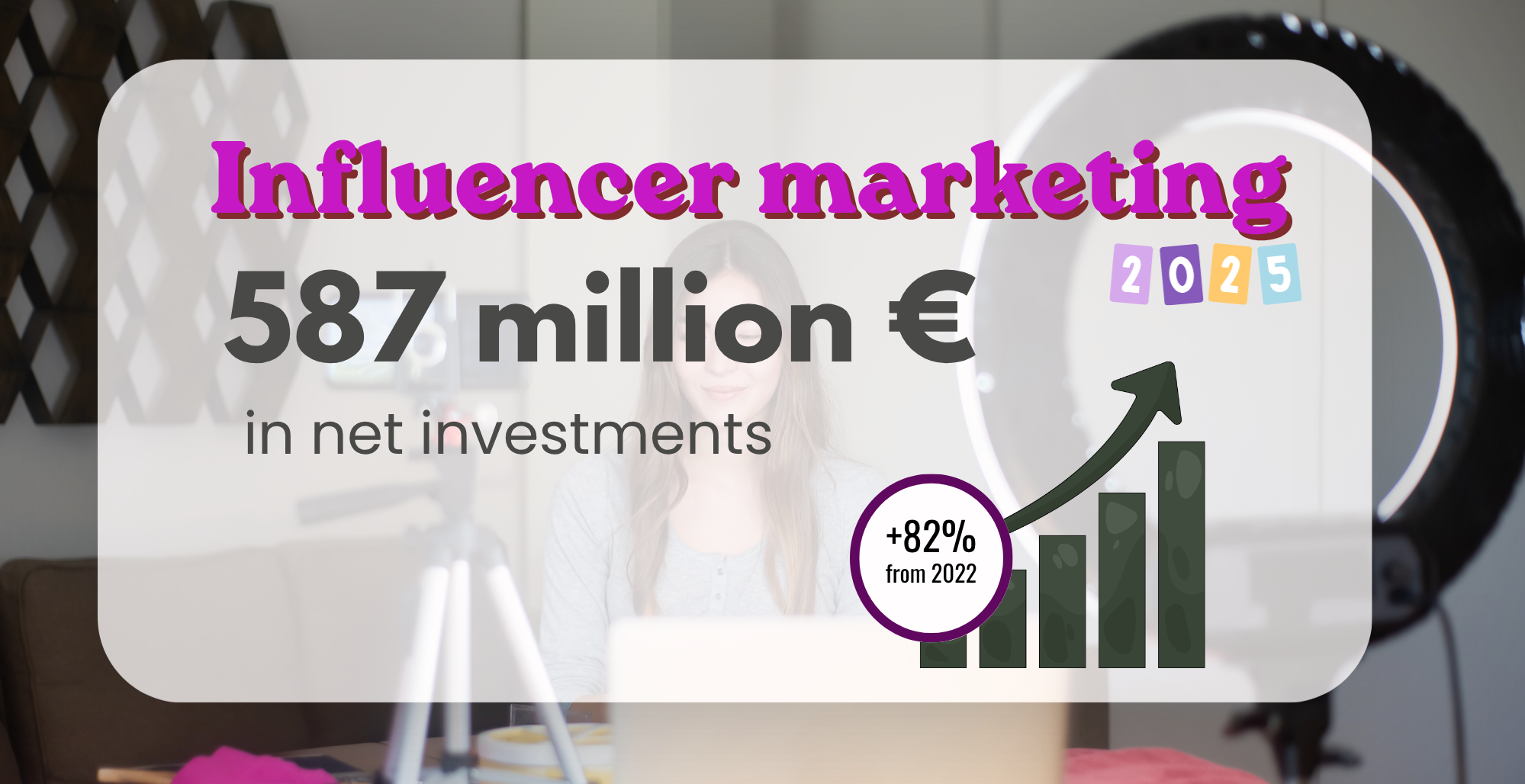
  • 587 million euros invested in influencer marketing in France in 2025, +13.1% over one year (ARPP/France Pub, April 2026)
  • +82% growth since 2022, while the global advertising market declined by 1.3% over the same period
  • 5.2% of total digital spend by French advertisers is now dedicated to it

📊 Nano, micro, macro: three approaches, three budgets

  • Nano-influencers (1K-10K followers): 8.3% average engagement rate, €50-300/post, ideal for local or niche targeting
  • Micro-influencers (10K-100K): 6.7% engagement, €300-1,500/post, the best reach/engagement ratio for SMEs
  • Macro-influencers (500K-1M): 2.5-3.5% engagement, €5,000-20,000/post, for large-scale launches

🎯 What you need to know before launching

  • Since the law of June 9, 2023, any paid influencer contract must be in writing and explicitly mention the commercial partnership
  • Target CPE (cost per engagement) in France: 0.10 to 0.50 €, this is your compass for evaluating a campaign
  • 65% of national advertisers now use an agency or an intermediary (compared to 37% in 2022)

That is what French advertisers invested in influencer marketing in 2025, up 13.1% over one year, in a global advertising market that itself declined by 1.3%. This is not a trend. This is a shift.

Yet, only 18% of national advertisers collaborated with content creators in 2025. The majority of French companies are still out of the game. Either because they do not know where to start, or because they tried and it did not work, often due to the lack of a clear method.

This guide covers the fundamentals: choosing the right type of influencer, writing a brief that works, understanding the law, and measuring what matters.

Article summary

  1. The market in 2025-2026: the numbers that change everything
  2. Nano, micro, macro: which type of influencer to choose?
  3. Which platform should you focus your budget on?
  4. How to write an effective brief ?
  5. What the 2023 law says about commercial influence ?
  6. How to measure the ROI of an influencer campaign ?
  7. What budget to plan based on your company size ?
  8. The 4 most common mistakes made by beginner advertisers
  9. Summary table
  10. FAQ

The market in 2025-2026: the numbers that change everything

Influencer marketing grew by 82% between 2022 and 2025 in France, rising from 323 million to 587 million euros in net investments (ARPP/France Pub, April 2026). Over the same period, the global digital market grew by only 8.2%, and the overall advertising market stagnated or even declined.

What has changed over these three years is the professionalization of the sector. In 2022, only one-third of advertisers financially compensated influencers, while the other two-thirds relied solely on gifting (sending products). In 2025, 84% of national advertisers opt for financial compensation. Creator content has become a service like any other, with a contract, brief, invoicing, and usage rights.

Another sign of maturity: 65% of advertisers now use an agency or a specialized intermediary, compared to 37% in 2022. SaaS tools (Kolsquare, Stellar, HypeAuditor, Traackr) have become democratized. Influencers are no longer chosen on a gut feeling or follower count; they are audited.

As for budgets, the distribution has evolved. 28% of national advertisers allocate less than 10,000 euros to influence, 50% invest between 10,000 and 50,000 euros, and 16% exceed 50,000 euros, compared to only 2% in 2022. The shift toward significant budgets is underway.

Nano, micro, macro: which type of influencer to choose?

The size of an influencer does not determine their effectiveness. It determines the type of objective they can serve. This is the fundamental distinction that many advertisers miss when looking for "the biggest accounts available."

Nano-influencers (1,000 to 10,000 followers) show an average engagement rate of 8.3%, the highest of all categories. Their audience is often hyperlocal or ultra-specialized in a niche: vegan cooking in a specific city, trail running in a department, homemade Lebanese food. For an SME looking to reach a specific community, they are often the best investment. Average rate: 50 to 300 euros per post.

Micro-influencers (10,000 to 100,000 followers) combine high engagement (6.7% on average) with sufficient reach for a launch or a regional awareness campaign. They have developed a clear editorial identity, a loyal audience, and, generally, professionalism in managing partnerships. These are the most versatile profiles for SMEs and mid-sized companies. Rate: 300 to 1,500 euros per post on Instagram, 300 to 1,500 euros for a reel or a TikTok video.

Macro-influencers (100,000 to 1 million followers) offer significant reach but lower engagement, 2.5% to 3.5% on average. They are suitable for national launches, pure visibility campaigns, or situations where raw reach takes precedence over engagement. Budget: 5,000 to 20,000 euros per post.

Mega-influencers (1 million+ followers) have an even more diluted engagement, 1.5% to 2.5%, but an audience on a national or international scale. Their relevance is real for major brands, less so for budgets under 50,000 euros.

The basic rule: if your goal is conversion or precise targeting, focus on nano and micro. If it is raw visibility, macro and mega are essential. The best mix, according to several industry studies, is 40% macro for reach, 30% micro for engagement, and 30% nano for niche targeting.

Which platform should you focus your budget on?

Instagram remains the reference platform, with 39% of allocated influencer budgets. It offers the best ecosystem for visual formats (Reels, Stories, carousels) and the highest concentration of professional influencers.

TikTok is establishing itself as the fastest-growing platform, with 28% of budgets and higher engagement dynamics than Instagram, especially among nano and micro-influencers. On TikTok, a nano-influencer can reach 10.3% engagement, compared to 2.71% on Instagram for the same profile. The difference is explained by the platform's algorithm, which distributes content to non-follower audiences.

YouTube captures 18% of budgets. Its strength is depth: a 10-minute tutorial or product review on YouTube has an infinitely longer lifespan than a Story. For products that require explanation (technology, beauty, cooking), it is often the most effective format.

LinkedIn is rising to 7%, on the increase, for B2B brands. The engagement there is different (long comments, professional shares), but the quality of the audience can justify the cost.

The choice of platform must stem from your audience, not your preferences. Ask yourself: where are your potential customers? Where do they consume content? It is not necessarily where your brand is already present.

How to write an effective brief ?

The brief is the document that defines the campaign. A vague brief produces vague content. A brief that is too restrictive smothers the creator's creativity and produces artificial content that their audience senses immediately.

A good brief consists of 5 elements.

1. Your brand context: 3-4 lines explaining who you are, your positioning, your values. Not your full history. The influencer needs to understand your world, not read your annual report.

2. The campaign objective: be explicit. Awareness? Traffic to a product page? Conversions via a promo code? Each objective implies a different type of content. Do not say "make our brand known," say "generate 200 clicks to our X product page within 48 hours."

3. Precise deliverables: type of content (reel, story, long video, carousel post), number of publications, delivery deadlines, approval format before publication. Allow at least 7 to 10 days between sending the brief and the delivery of the first content; a solo creator does not have a production team.

4. Key messages: 2 or 3 points that the content must convey. Not an imposed script. The influencer knows their audience better than you do: they know how to talk to them, what tone to adopt, what angles work. Give them the messages, not the words.

5. Constraints and mandatory mentions: since the 2023 law, the mention "advertising" or "commercial partnership" is mandatory on all paid content. Also specify: any hashtags, usage rights for the produced content (to reuse it in your own paid campaigns), and exclusivity clause if necessary.

What the 2023 law says about commercial influence ?

The law of June 9, 2023 regulated influencer marketing in France. It came into force progressively and applies to any contract between a brand and an influencer operating from France or targeting a French audience.

The main obligations for advertisers:

Mandatory written contract for any paid collaboration (cash or in-kind) beyond a certain threshold. The contract must specify: deliverables, timeline, compensation, content usage rights, and an approval clause before publication.

Visible advertising mention: sponsored content must be clearly identified as such, using the disclosures "Publicité" or "Collaboration commerciale". This mention must be legible, in French, and appear right at the beginning of the content, not buried in the hashtags at the bottom of the description.

Prohibited practices: promotion of cosmetic surgeries that are not medically indicated, unauthorized gambling, fraudulent financial products, and prescription drugs. The law also prohibits the promotion of products that have undergone filters or modifications likely to mislead regarding their reality.

In practice, legal compliance is simpler than it seems. The vast majority of legitimate brand campaigns have no trouble respecting these rules. The risk is mostly for influencers who do not properly disclose their partnerships, but as an advertiser, it is in your best interest to contractualize this obligation to avoid being exposed.

How to measure the ROI of an influencer campaign ?

The ROI of influencer marketing is measured differently depending on your objective. The classic mistake is using the same metrics for different goals.

For an awareness objective, the relevant metrics are: reach, impressions, and EMV (Earned Media Value), an estimate of what the same exposure would have cost in paid advertising.

For an engagement objective, the main KPI is the CPE (cost per engagement). In France, a healthy CPE is between 0.10 and 0.50 euros. If your campaign generates 10,000 engagements (likes, comments, shares, saves) for a budget of 2,000 euros, your CPE is 0.20 euros, within the target zone.

For a conversion objective, use unique promo codes per influencer, tracked UTM links, and dedicated landing pages. Each influencer has their own code: code ALICE10, code THOMAS15. This allows you to calculate the revenue generated per creator and figure out a direct ROI.

A point on method: set your benchmarks before launching. Not after. Aim for a 2 to 5% engagement rate, a 1 to 3% click-through rate, and a 3 to 5% conversion rate on influencer traffic.

>>> How to calculate the ROI of your influencer campaign?

What budget to plan based on your company size ?

Data from ARPP/France Pub gives a good picture of what advertisers actually invest. 50% of national advertisers dedicate between 10,000 and 50,000 euros per year to influencer marketing.

For a first campaign, here are the realistic ranges:

Local awareness campaign (SME): 3 to 5 regional micro-influencers, 1 publication each, total budget 2,000 to 5,000 euros.

Product conversion campaign (e-commerce): 2 to 3 micro-influencers with a trackable promo code, budget 1,500 to 5,000 euros + potential commission on sales.

UGC (User-Generated Content) campaign: 1 to 2 influencers who create content that you reuse in your own paid advertisements, budget 1,000 to 3,000 euros for production, then your usual paid media budget for distribution.

>>> Activate your social media and influencer campaigns on Adintime

The 4 most common mistakes made by beginner advertisers

Choosing based on follower count. An account with 500,000 followers and a 1.5% engagement rate is often worth less than an account with 20,000 followers and an 8% engagement rate within your specific target. Look at the engagement rate first.

Imposing a word-for-word script. Influencer audiences are sensitive to authenticity. When content sounds like a press release read by someone who does not believe in what they are saying, it shows. Give them the messages, not the sentences.

Neglecting legal approval. Since 2023, a written contract is mandatory. The advertising disclosure is mandatory. This is not a formality; it is a protection for both parties.

Measuring too early or too late. Define a measurement window (7 to 30 days depending on the format), identify your KPIs before the campaign, and compare them to the benchmarks you set. Without a baseline, it is impossible to know if it is working.

Summary table: types of influencers and recommended uses

Tier Followers Avg. engagement Est. rate (IG) Recommended use
⚡ Nano 1K to 10K 8.3% €50 - €300 /post Local targeting, precise niche, authenticity
🚀 Micro 10K to 100K 6.7% €300 - €1,500 /post Reach/engagement balance, SMEs & SMBs
💥 Mid-tier 100K to 500K 3.5% - 5% €2,000 - €8,000 /post National campaigns, product launches
👑 Macro 500K to 1M 2.5% - 3.5% €5,000 - €20,000 /post National awareness, mass appeal
🔮 Mega / Celeb 1M+ 1.5% - 2.5% > €20,000 /post Brand image, massive audiences

Influencer marketing is no longer an option

587 million euros invested in 2025. Double-digit growth for the third consecutive year. 69% of advertisers planning to further increase their budget in 2026. The numbers tell a simple story: influencer marketing has become a channel in its own right, not a communication gimmick.

What remains true is that simply sending a product to an influencer is not enough for the magic to happen. The campaigns that work are those that start with a clear objective, choose the right profile for that objective, rely on a solid brief, and measure with the right indicators.

For companies that have not yet activated this channel, the good news is that the entry point is more accessible than ever: a campaign with 3 targeted micro-influencers can be launched for less than 3,000 euros and produce measurable results in less than a month. To integrate it into a cross-channel strategy, combine influence with your other media placements.

>>> Contact us directly for more details for your influencer campaign and get a free quote

FAQ: Everything you need to know about influencer marketing

What is influencer marketing and how does it work?

Influencer marketing consists of collaborating with content creators (influencers) to promote a brand, product, or service to their audience. The brand pays or rewards the creator in exchange for sponsored posts on their social networks. The principle relies on the trust the audience places in the creator: a recommendation from a followed influencer is perceived as more authentic than traditional advertising.

What is the difference between a nano, micro, and macro-influencer?

The difference is primarily a matter of audience size, followed by engagement. Nano-influencers (1K-10K followers) have the highest engagement rates (8.3% on average) but a limited reach. Micro-influencers (10K-100K) offer a good balance. Macro-influencers (500K-1M) reach a large audience but with more diluted engagement (2.5-3.5%). For a first campaign with a limited budget, micro-influencers are generally the best starting point.

What budget should you plan for an influencer campaign in France?

According to ARPP/France Pub data (2026), 50% of national advertisers invest between 10,000 and 50,000 euros per year. For an initial test campaign, a budget of 2,000 to 5,000 euros allows you to collaborate with 3 to 5 micro-influencers and get measurable results. For a local SME, campaigns with nano-influencers can start from 500 to 1,500 euros.

What are the legal obligations since the 2023 law?

The law of June 9, 2023 mandates: a written contract for any paid collaboration, the disclosure "Publicité" or "Collaboration commerciale" visible and legible on all sponsored content, and the prohibition of certain practices (cosmetic surgery not medically indicated, unauthorized gambling, fraudulent financial products, etc.). The advertising disclosure must appear right at the beginning of the content, not just in the hashtags.

How do you measure the effectiveness of an influencer campaign?

Indicators vary depending on the objective. For awareness: reach, impressions, EMV (Earned Media Value). For engagement: engagement rate and CPE (cost per engagement, target: 0.10 to 0.50 € in France). For conversions: unique promo codes per influencer, tracked UTM links, and conversion rates on the generated traffic. Set your benchmarks before the campaign, not after.

Which platform should you start with?

Instagram remains the reference platform (39% of influencer budgets in France), with the largest pool of professional creators. TikTok is preferred if your target is young (18-34 years old) or if you are looking for strong organic reach. YouTube is relevant for products that require explanation. For a first test, choose the platform where your target audience is most active, not necessarily where your brand is already present.

Related products

Related posts