New ! Find your advertising panels at a glance  DISCOVER

Conversion funnel : What stages and how to optimize it ?

Pôle Marketing

Article summary: The conversion funnel

💡 The definition made clear

  • The conversion funnel models the path an unknown person takes toward making a purchase, broken down into steps that can be measured one by one.
  • The most common breakdown: TOFU (awareness), MOFU (consideration), BOFU (decision), plus a retention stage.
  • Not to be confused with the customer journey: the funnel is the analytical model, while the journey describes the prospect's real-life experience.

📊 The numbers that matter

  • An optimized funnel converts 2% to 5% of visitors into clients depending on the industry (1.8% to 3.2% in e-commerce).
  • A bottom-of-funnel landing page converts 15% to 30%, compared to 1% to 3% for a standard homepage.
  • 79% of leads never convert, most often due to a lack of follow-up.

🎯 Where to take priority action

  • Measure the drop-off rate between each step and identify your largest leak.
  • The top of the funnel is fueled by media advertising: display, social networks, and billboards.
  • An existing customer buys again 60% to 70% of the time: do not neglect post-purchase retention.

Nobody buys on the first contact. A prospect interacts on average 7 to 13 times with a brand before taking action. The conversion funnel serves precisely to understand this path and, above all, to see where your prospects drop off.

It is a management tool, not a theoretical concept. Used well, it shows you in black and white which step is costing you the most sales, and therefore where to focus your efforts and media budget.

We will lay down the definition, detail the steps and their indicators, provide benchmark figures by sector, and then see how advertising feeds the top of the funnel.

Article summary

  1. Conversion funnel: definition
  2. Conversion funnel or customer journey?
  3. The stages of the funnel: TOFU, MOFU, BOFU
  4. Indicators to track by stage
  5. Conversion benchmarks by sector
  6. How to identify and fix leaks ?
  7. The role of media advertising in the funnel

Conversion funnel: definition

The conversion funnel Also known as a conversion funnel, it is a model that breaks down a prospect's path into steps, from the first contact to the purchase. We speak of a funnel because the volume decreases at each step: many curious people at the top, few customers at the bottom.

Its real value lies beyond the diagram. By comparing the number of people at each stage, you get progression rates. These rates turn a vague intuition ("we are losing people somewhere") into a precise diagnosis ("we are losing 80% of prospects between the visit and the first contact").

📋 An example illustrates this better than a definition:

A software publisher observes 10,000 visitors over a month, of which 2,000 check the pricing page (20%), 500 start a free trial (25%), and 100 subscribe (20%). Overall conversion rate: 1%. Each percentage indicates a step in the funnel, and each can be improved independently.

Conversion funnel or customer journey?

The two are often confused, mistakenly:

The customer journey

The customer journey describes the experience lived: what a prospect feels, looks for, and does at each point of contact with the brand. It is a human and qualitative vision.

The conversion funnel

The conversion funnel, on the other hand, is the analytical model. It counts, it measures, it calculates rates. Where the journey tells a story, the funnel gives numbers.

💡 The two complement each other. The journey helps you understand why people drop off; the funnel tells you where.

>>> Our article dedicated to the customer journey explores the experience dimension deeper.

The stages of the funnel: TOFU, MOFU, BOFU

The most common breakdown consists of three parts, plus a stage that is too often forgotten.

1. TOFU (top of funnel), discovery

The prospect becomes aware of a need or discovers your brand. This is the realm of volume: SEO, social networks, display advertising, billboards. The goal is not to sell, but to get known by the right audience.

2. MOFU (middle of funnel), consideration

The prospect compares, evaluates, hesitates. They read guides, look at case studies, or download content. This is the most neglected stage, yet it determines the quality of your pipeline.

3. BOFU (bottom of funnel), decision

The prospect is ready but wants one final argument: a demo, a free trial, a reassuring review, an offer. The pages at this stage convert immensely when well-crafted.

4. Retention

This takes place after the purchase. It deserves careful attention: an existing customer buys again 60% to 70% of the time, compared to 5% to 20% for a cold prospect. Ignoring post-purchase means leaving money on the table.

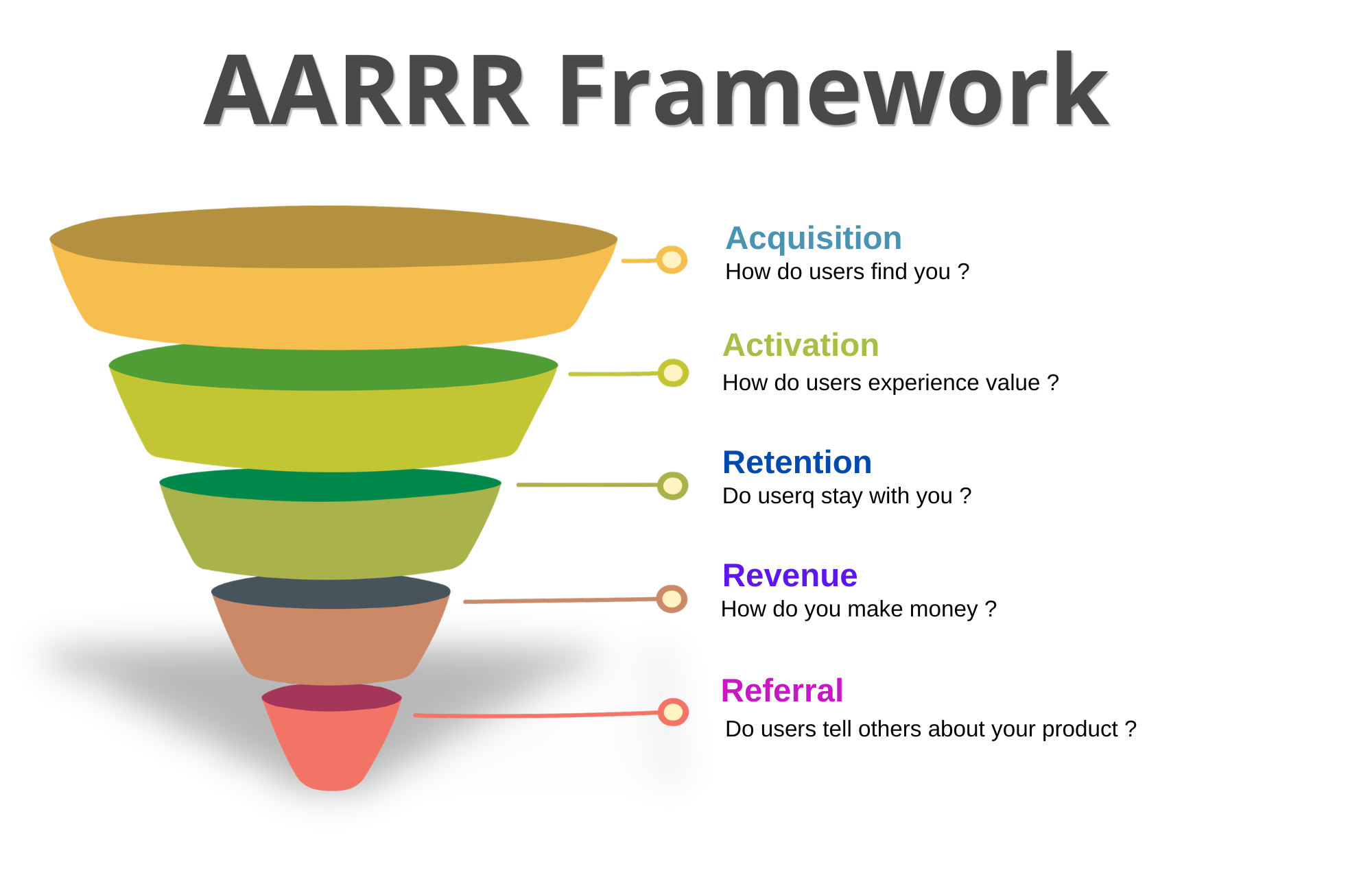
Growth marketing advocates will recognize the logic of the AARRR model (acquisition, activation, retention, revenue, referral), which simply pushes the reasoning all the way to recommendation. Regardless of the vocabulary, the idea is always to break it down in order to measure.

Indicators to track by stage

Each stage has its own indicators. Mixing them up is the easiest way to make the wrong diagnosis.

StageObjectiveKey Indicators
TOFUBuilding awarenessImpressions, reach, visitors, CPM, bounce rate
MOFUQualifying prospectsVisitor-to-lead rate, cost per lead, engagement
BOFUConvertingLead-to-customer rate, acquisition cost, average order value
RetentionDriving repeat purchasesRepeat purchase rate, customer lifetime value, referral

Conversion benchmarks by sector

A benchmark should not be blindly copied; it serves as a point of reference to locate your performance. Here are recent orders of magnitude across all sectors.

SectorVisitor-to-leadOverall conversion
E-commerce3% to 5%1.8% to 3.2%
B2B Services5% to 12%1% to 5%
B2B SaaS5% to 10%0.8% to 2.5%

💡 Two useful pointers for reading these figures: If your visitor-to-lead rate is below your sector's low range, the issue is at the top of the funnel: content, messaging, targeting. If it is the lead-to-customer rate that stalls, look into the middle and bottom sections: follow-ups, qualification, offer.

How to spot and fix leaks?

The methodology is simple, which does not mean easy. It unfolds in three steps.

➡️ First, measure the drop-off rate between each stage over the last three to six months. This gives you a sequence of percentages. The lowest step compared to its benchmark is your priority leak point.

➡️ Next, prioritize high-volume, low-rate transitions. Improving a step by two percentage points when it processes thousands of people yields higher returns than optimizing an already good step that only sees a few prospects.

➡️ Finally, act in the right place. The middle of the funnel is often completely forgotten: 79% of leads never convert, mostly due to a lack of follow-ups. A well-designed nurturing workflow is inexpensive and can be measured in thirty days. Do not fix the top of the funnel if the leak is in the middle.

The role of media advertising in the funnel

A funnel does not fill itself. Without a steady stream of new qualified visitors at the top, the rest dries up. This is where media advertising comes into play.

The top of the funnel is the playground for awareness and traffic media. Display and programmatic advertising reach broad audiences at a controlled cost. Social networks capture attention and generate discovery. Billboard advertising, on its part, establishes the brand in the physical space and drives recall.

>>> Discover our billboard and programmatic display offers here

>>> For social media advertising offers

💡 The right reflex is to align the medium with the stage. You don't ask a billboard campaign to trigger an immediate sale; you ask it to fill the top of the funnel so that the rest has material to convert. This is the exact logic of a cross-channel strategy: each lever in its place, each measured against the right objective.

For tighter budgets looking to start out properly, our guide on launching a campaign for under €2,000 shows how to seed the top of the funnel without breaking the bank.

Summary table

QuestionShort answer
The stagesTOFU, MOFU, BOFU, retention
Target overall conversion2% to 5% depending on the sector
Most neglected stageThe middle (MOFU) and follow-ups
Top of funnel mediumDisplay, social, billboards

Fill the top of your funnel

A well-optimized funnel without traffic remains empty. Once your stages are measured, the priority is to fuel the top with qualified audiences.

Adintime allows you to purchase ad space in display, social media, and billboards without intermediaries, and to manage your awareness as well as traffic campaigns. Everything you need to continuously feed your funnel.

>>> Fuel your funnel with our offers on Adintime

FAQ: everything to know about the conversion funnel

What are the stages of a conversion funnel?

The classic breakdown includes three main stages: TOFU (awareness), MOFU (consideration), and BOFU (decision), followed by a retention stage. Some models like AARRR add referral into the mix.

What is the average conversion rate of a funnel?

It varies greatly by industry: around 1.8% to 3.2% in e-commerce, 1% to 5% in B2B services, and 0.8% to 2.5% in SaaS. Bottom-of-funnel pages convert at much higher rates, between 15% and 30%.

What is the difference between a conversion funnel and a customer journey?

The funnel is the analytical model that measures the progression rates between stages. The customer journey describes the actual experience lived by the prospect. The former tells you where people are dropping off, while the latter helps explain why.

Where does my funnel lose the most prospects?

Most often in the middle: 79% of leads never convert, primarily due to a lack of follow-up. Measure the conversion rate between each step and focus on the lowest step relative to its benchmark.

Which media channels should be used to fill the top of the funnel?

Awareness and traffic media channels: display and programmatic advertising, social networks, and billboards. Their role is to drive qualified volume, not to trigger immediate sales.

Related products

Related posts