New ! Find your advertising panels at a glance  DISCOVER

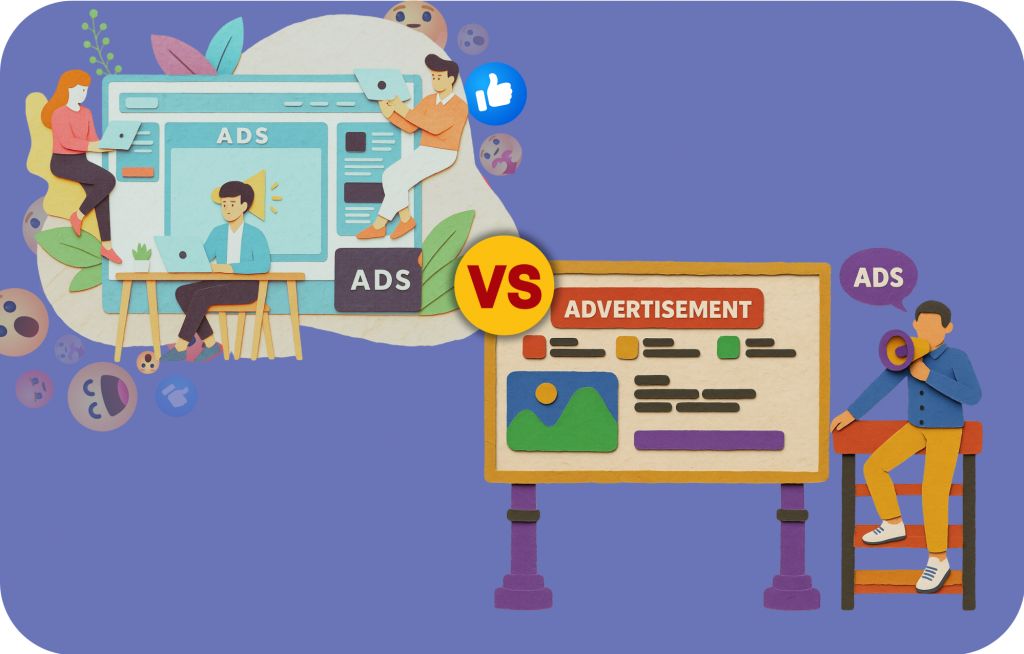
Digital vs traditional advertising : How to choose in 2026 ?

Pôle Marketing

Article summary : Digital or traditional media ?

The state of the market in 2026

  • In France, digital now accounts for over 63% of advertising investments (10.9 billion euros out of 19.8 billion in total, source BUMP 2024).
  • However, traditional media (TV, radio, OOH, press) still total around 7 billion euros and are not disappearing.
  • The real question is not "digital or traditional?" but "which channel for which objective?"
  • Campaigns that combine both are on average more effective than single-channel campaigns.

What each type of media really does

  • Digital excels in direct performance: precise targeting, immediate measurement, calculable ROAS.
  • Traditional media excel in mass awareness: fast coverage, recall, legitimacy.
  • TV remains the most powerful brand-building media in France for large audiences.
  • Outdoor advertising and local radio are the most accessible levers for SMEs wanting a local presence.

How to decide

  • Fast awareness objective on a large audience → traditional media (TV, radio, OOH).
  • Measurable direct performance objective → digital (search, social ads, performance display).
  • Sustainable growth objective for a brand → a mix of both, using digital to capture and traditional media to build.

In 2026, the question “should we do digital or traditional advertising?” is no longer really the right one. The real trade-off lies elsewhere: understanding what each channel can do, what it cannot do, and building a response tailored to your situation, your budget, your target audience, and your objectives.

What is certain is that both worlds coexist and complement each other. TV still accounts for 3.5 billion euros of investment in France. Outdoor advertising is on the rise, driven by DOOH. And digital continues to grow, but at a normalizing pace. The question is no longer “which one wins?” but “how to articulate them?”

Article summary

  1. Digital and traditional advertising: what are we talking about?
  2. The strengths of digital
  3. The strengths of traditional media
  4. Limitations and blind spots of each approach
  5. The criteria for deciding
  6. Why the mix is often the right answer?
  7. SME case study: how to decide with a small budget?

Digital and traditional advertising: what are we talking about?

Digital advertising covers all formats broadcast on the internet and digital platforms: search advertising (Google Ads, Bing), social ads (Meta, TikTok, LinkedIn, Snapchat), programmatic display, online video (YouTube, social networks), retail media (Amazon, major supermarket chains), and streaming audio advertising (Spotify, Deezer).

Traditional media refers to so-called “classic” or “historical” media: television (national, addressable, local), radio (national, local), press (dailies, magazines, free newspapers), and outdoor advertising (OOH) in its classic and digital (DOOH) forms.

This boundary has blurred a lot in recent years. Addressable TV can now be purchased through interfaces close to programmatic. DOOH can be managed in real time. And radio has its own digital offers via podcasts and audio streaming. What is changing most is the method of purchasing and targeting, rather than the channel itself.

The strengths of digital

Precise targeting

This is the number one argument. Digital platforms allow targeting by age, gender, location, interests, purchasing behavior, funnel stage, or visitors to your site. A level of precision impossible to achieve in national TV or large-format outdoor advertising.

Direct and immediate measurement

Every click is tracked. Every conversion is attributed (admittedly, with its limitations). The ROI of a Google Ads campaign can be calculated down to the euro, which a radio campaign does not allow. This is a decisive advantage for companies that need to justify every expense or optimize in real time.

Budget accessibility

There is no legal minimum to start a Google Ads or Meta Ads campaign. In practice, an SME can test with a few hundred euros and scale up progressively. It is much more flexible than buying a TV spot or a national outdoor advertising wave.

Speed and flexibility

A digital campaign can be launched in a few hours, modified in real time, and stopped immediately if necessary. Traditional advertising requires much longer production and booking deadlines.

Retargeting and personalization

Digital allows you to retarget your site visitors, cart abandoners, or past buyers with personalized messages. This is a conversion lever that does not exist in traditional media.

The strengths of traditional media

Coverage and firepower

A national TV campaign can reach 5 to 10 million people in a single evening. A 4x3 billboard in a major city is seen thousands of times a day. This ability to quickly cover a large audience remains unmatched by digital for mass campaigns.

Recall and emotional impact

Post-test studies consistently show that TV generates very high recall rates: often 40 to 70% aided recall for a good creative. The sensory experience of a TV spot or a large-format billboard creates an impact that digital scrolling rarely reproduces.

Legitimacy and trust

Being present in a leading magazine, on national radio, or in TV prime time confers a legitimacy that digital advertising struggles to match. A Kantar/IPSOS study published in 2024 showed that consumers still place higher trust in TV and press advertisements than in digital advertisements.

Effectiveness for targets difficult to reach in digital

Seniors (55 years and older) consume an average of 4 hours of TV per day and regularly listen to the radio. They are much less accessible through traditional digital platforms. To target this age group, traditional media often remain more effective.

Absence of digital-related phenomena

No click fraud, no viewability issues (was my ad really seen?), no ad blockers. The broadcasting of a TV spot is guaranteed, monitored, with audiences measured by Médiamétrie.

Limitations and blind spots of each approach

The limitations of digital

Competitive noise is intense

An internet user is exposed to several hundred advertisements per day. Standing out in this saturated environment requires highly crafted creatives and very precise targeting, which costs more than the basic CPM suggests.

Attribution is imperfect

Last-click attribution models overvalue certain channels (especially search) and undervalue those that helped build demand upstream (TV, social). A digital campaign sometimes appears less effective because it benefits from demand created elsewhere.

Costs are increasing

Digital CPM grows every year on major platforms (Meta, Google) as the demand for space increases and algorithms adapt. The profitability of a Meta Ads campaign in 2026 is no longer the same as in 2019.

The limitations of traditional media

Targeting is less precise

A national TV campaign reaches a broad audience, a large part of which does not match your target. The cost of "waste" (out-of-target contacts) is integrated into the global cost.

Direct measurement is limited

Except for specific protocols (promo codes, dedicated numbers, lift studies), it is difficult to directly measure the sales generated by a radio or outdoor advertising campaign. It is not the same management logic as a digital ROAS.

Production delays and minimums

A TV spot requires weeks of production. A national outdoor advertising wave is sometimes booked several weeks in advance. Flexibility is structurally lower than in digital.

The criteria for deciding

Here are the questions to ask yourself before making a choice:

QuestionFavors digitalFavors traditional
What is the main objective?Direct performance, conversion, leadsAwareness, recall, legitimacy
Who is the target audience?Connected 18-45 year olds, specific nichesSeniors, broad audiences, precise geographies
What is the available budget?Small (from €500/month) to mediumMedium to large (from €3,000 for local)
How fast to measure?Immediately (clicks, conversions)Medium term (awareness, recall)
Is the brand well-known?Yes (capturing existing demand)No (creating demand)
Broadcast area?National or internationalLocal or regional (radio, OOH, local press)

Why combining channels is often the right answer?

Studies on the effectiveness of advertising campaigns consistently show that a multi-channel strategy outperforms single-channel approaches. Not because "more channels = better", but because different channels play complementary roles in the buying journey.

The most effective model is often the following:

Traditional media create demand: TV, radio, and OOH build awareness, anchor the message, and generate brand searches. This is the top of the funnel.

Digital captures the created demand: When someone searches for your brand on Google after seeing your TV spot, search is there to convert. Display and social fuel consideration in the middle of the funnel.

Brands that cut their TV budget to put everything into search often see their brand search volumes gradually decline because they are no longer feeding demand upstream. And brands that only do TV without digital miss out on the conversion stage.

>>> Discover how to structure an effective cross-channel strategy

SME case study: how to decide with a small budget?

For an SME with a limited budget (€5,000 to €20,000 per year), here is how to think about the trade-off:

If you are in a launch phase or little-known locally: start with a medium that gives quick local visibility: local radio, regional outdoor advertising, or local press. In parallel, set up the vital minimum in digital: a Google Ads page targeting your brand name and your main product/service queries.

If you are well-known but looking to convert: focus on digital (search, social) to capture existing demand. Add a traditional medium to maintain your presence in people's memory between two buying cycles.

If you target seniors or a less-connected clientele: traditional media are essential. Radio and local press provide access to an audience that is difficult to reach via digital.

The Adintime platform allows campaigns for SMEs to directly access the inventories of local ad networks, without intermediaries. It is often the most accessible way to test traditional media before investing more heavily.

>>> Discover our radio, outdoor advertising, press and social media offers

>>> Get inspired by this article to get an idea of how to launch with a budget under €2,000

Summary table

CriterionDigital advertisingTraditional media
TargetingVery precise (behavioral, intent-based)Broad (socio-demographic, geo)
MeasurementImmediate and directIndirect, post-test necessary
Minimum budgetFrom €500/monthFrom €800 to €3,000 (local)
Main objectivePerformance, conversionAwareness, recall
FlexibilityVery high (modifiable in real time)Lower (production delays)
Perceived trustGrowing but lowerHigh (TV, press)

>>> Feel free to contact us for your campaign projects

FAQ: Digital vs traditional advertising

What is the difference between digital advertising and traditional advertising?

Digital advertising includes formats broadcast online: search ads, social ads, display, online video, and retail media. Traditional media refers to TV, radio, press, and outdoor advertising. The main difference lies in the targeting method (precise vs broad), measurement (direct vs indirect), and flexibility (real-time vs planned).

Is digital more effective than TV?

That depends on the objective. For direct performance (conversions, leads), digital is generally more effective and measurable. To build broad awareness and lasting recall, TV remains an unmatched medium. Studies show that combining the two systematically outperforms single-channel approaches.

What is the minimum budget to start with digital advertising?

Technically, a few euros a day are enough. In practice, to obtain optimizable results, plan for a minimum of €500 to €800 per month on a single channel (Google Ads or Meta Ads). Below that, volumes are too low to learn and improve performance.

Can SMEs use traditional advertising?

Yes. Local radio is accessible from €3,000 to €5,000 for a 2-week wave. The regional press accepts inserts starting from €800. Outdoor advertising in a mid-sized city can start around €3,000. Platforms like Adintime provide direct access to these inventories without going through an agency.

How do you measure the effectiveness of a traditional media campaign?

By creating dedicated indicators: a unique telephone number for the campaign, an exclusive promo code, a specific URL with UTM tracking, or monitoring spikes in web traffic or brand searches during the broadcast. For major campaigns, a post-test study (aided/spontaneous awareness, recall) allows evaluating the impact on brand image.

What share of ad investments goes to digital in France?

In 2024, digital represented more than 63% of advertising revenues in France, i.e., around 10.9 billion euros out of a total market of 19.8 billion (BUMP source / France Pub). Traditional media (TV, radio, press, outdoor advertising) total around 7 billion euros, showing stronger resilience than many anticipated a few years ago.

Related posts