New ! Find your advertising panels at a glance  DISCOVER

OOH Advertising: My honest review

Pôle Marketing

Want to save time ?

Get this article summarized in seconds with AI

When it comes to billboard advertising, I often hear two opposing reactions:

  • On one hand, the skeptics, who believe it’s an outdated medium in our digital-first world.
  • On the other, the idealists, who imagine it as a miracle solution capable of solving everything instantly.

👉 The reality is far more nuanced.

Billboard advertising works—and it works very well. However, it’s not a monolith. Not every format pursues the same goal, delivers the same impact, or is used in the same way. This is exactly where the trouble starts: we sometimes expect billboards to generate immediate leads or explain complex offers, whereas their true power lies in repetition, physical presence, and brand recall.

I’m Lise. After 5 years at Adintime analyzing thousands of campaign data points, I’m giving you my unfiltered analysis. Here is what billboards actually do best, what they are too often wrongly expected to do, and why choosing the right format is far more strategic than simply "running an ad."

1. Why I believe outdoor advertising remains a powerful medium

If I love outdoor advertising today, it isn’t out of habit or nostalgia for "traditional" media. It’s because, in the reality of the field, it remains one of the few channels capable of reaching a local audience massively, visually, and with lasting impact.

Looking at the numbers, the French media market maintains positive momentum (+2.1% over the first nine months of 2025). As for outdoor advertising, the results seem more mixed with an overall decline of -6.1%. But this figure hides a profound shift: the digital transition is accelerating. DOOH surged by +20% compared to 2023 and now appeals to 45% of advertisers. The same goes for the "shopping" segment (displays in malls and retail spaces), which grew by +8.9%. Proof that immediate proximity to the act of purchase remains a sure bet.

OOH is an appealing medium because it establishes itself in daily life without being intrusive. We encounter it on the way to work, while grocery shopping, or taking public transport. This repeated presence at key moments of daily life naturally creates brand recall—and that is the Holy Grail for building brand awareness.

It is no coincidence that nearly one in two French people feel that posters catch their eye, and 43% consider that they create a connection with a brand. OOH isn’t trying to get a "click" or convince you immediately; it establishes presence, recognition, and familiarity.

2. The mistake I see most often with outdoor advertising

In my view, the most frequent mistake in outdoor advertising is misdefining expectations. We sometimes ask it to do things it simply isn’t designed for, such as:

  • generating immediate leads,
  • explaining a complex offer,
  • triggering instant action.

OOH is not a direct response medium. That is not its role. Its strength lies not in the click, but in repetition, presence, and brand recall.

Another recurring mistake is talking about "outdoor advertising" as if it were a single, uniform medium. In reality, formats, locations, and exposure duration completely change the nature of the impact. For me, this is where the real strategic work begins.

3. Classic OOH: my take on its true role

If I had to summarize classic OOH in one sentence, I’d say it is the best ally for establishing a brand within a territory. Billboards, street furniture, local posters: these formats offer broad and consistent coverage across a given area.

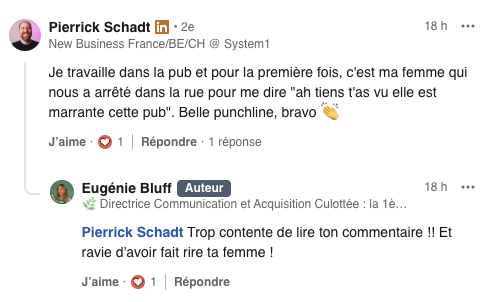
The other day, I came across a perfect example on LinkedIn regarding the campaign for the brand Les Petits Culottés. Beyond the quality of the visuals and locations, one comment really stood out to me:

“I work in advertising, and for the first time, it was my wife who stopped us in the street to tell me, 'Hey, look, did you see that? That ad is funny.' Great tagline, bravo 👏”

When passersby literally stop in the street to comment on a poster, that’s when you realize the true impact of a campaign.

However, let's be clear: this is not the format I recommend when the objective is to persuade or explain. OOH works best when the message is simple, readable, and instantly recognizable.

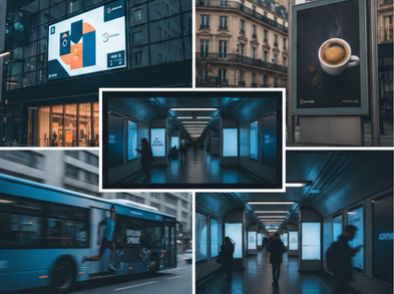
4. DOOH: an eye-catching and powerful format

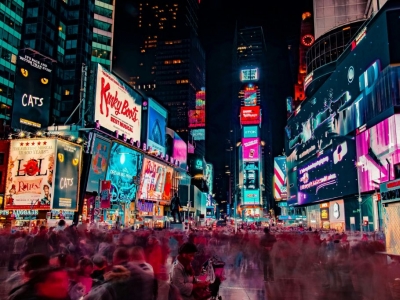
DOOH naturally grabs attention. Illuminated screens, motion content, premium locations… its visual impact is undeniable. But in my opinion, its real strength lies in its agility.

Unlike static paper ads that are locked in for a week, DOOH allows for powerful contextualization. You can adapt the message almost instantly: pushing an umbrella promo if it rains, changing the creative based on the time of day, or targeting a very specific geographic area.

However, my view remains firm: DOOH is an excellent amplifier, but I do not believe it constitutes a standalone strategy.

Placed in high-footfall locations (stations, malls), it reinforces an already established message. On the other hand, betting solely on DOOH without a broader coverage logic seems risky to me. To me, the winning equation is often this: OOH for territorial grounding, and DOOH for stand-out visibility and tactics.

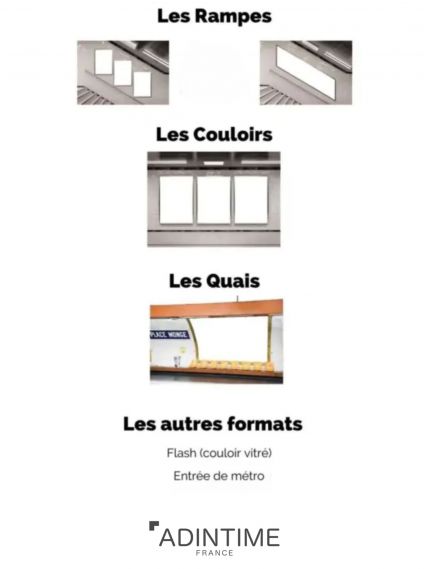
5. Subways and stations: where repetition makes all the difference

In my eyes, this is one of the most powerful drivers for brand recall. Why? Because it turns wait time into attention time.

The audience, captive to their daily commute, is exposed to the message following a biological rhythm: in the morning on the way to work, and in the evening on the way home. This mechanical repetition creates a deep memory anchor. It is the premier format for brands looking to establish a lasting presence in users' minds and shift from being a "known brand" to a "household name".

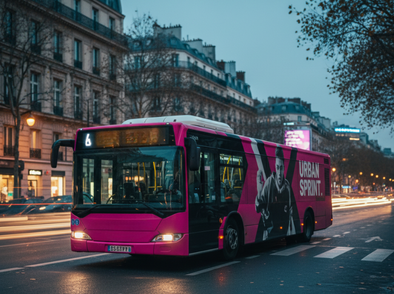
6. Bus advertising

Where other formats wait for the customer, the bus goes to them. Its major asset is its mobility: the brand becomes mobile, traversing business districts as well as residential areas to capture highly diverse audiences.

I often recommend this format to build local coverage with an affordable entry point for small businesses. It is the ideal complement to a static campaign: it allows you to blanket the territory and be seen everywhere.

>>> Advertise on buses

7. Long-Term or Temporary: Which Strategy to Choose?

While both options are available for almost all formats, they serve very different strategic purposes.

  • Looking to drive footfall to your point of sale or become a neighborhood staple? Prioritize Long-Term Display (+30 days). By purchasing your billboards individually, you control the specific location for an effective drive-to-store strategy.
  • Want to create a buzz, launch a product, or target an entire city? Opt for Temporary Display (7 to 15 days). Buying through a network provides dense coverage that significantly boosts brand awareness.

Conclusion

In an era where everything is going digital, outdoor advertising retains an irreplaceable quality: it is real. It doesn't hide behind an ad blocker, and you can’t scroll past it in half a second.

My honest opinion? Billboards remain the best way to prove that a brand exists "in the real world." I hope this analysis helps clarify things for you.

And if you want to move from theory to practice and visualize these opportunities around you, I invite you to take a look at our map listing billboards across France. That is often where it all begins.

Sources : CBNEWS / LSA & BUMP 3T 2025 

Related products

Related posts