Street marketing covers all communication activities carried out in public spaces to reach a localised audience in a direct and memorable way.
Unlike traditional advertising, it is interactive: passers-by are not just spectators — they live an experience.
70% of consumers remember a brand after interacting with it during a street marketing activation (Marketing Actu, 2024).
Entry budget: a few hundred euros for a targeted flyer campaign; €5,000 to €50,000 for a multi-city experiential activation.
📊 The figures behind its effectiveness
78% brand recall for guerrilla marketing, versus 35% for traditional outdoor advertising (Ipsos, 2024).
Average ROI estimated between €3 and €5 for every euro invested in a well-executed campaign.
Mobile advertising vehicles attract 2.5 times more attention than static billboards.
+40% pedestrian traffic in the targeted area during a well-organised street marketing event.
💡 5 examples to remember
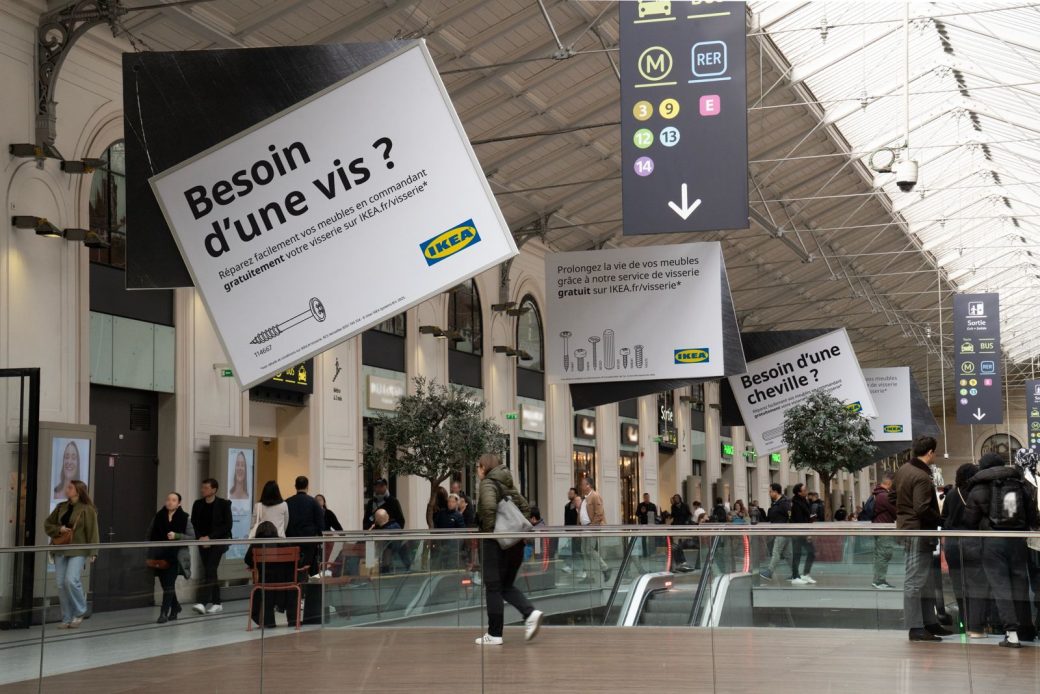
IKEA x Buzzman (2025): tilted advertising panels at Gare Saint-Lazare promoting their free screw-tightening service.
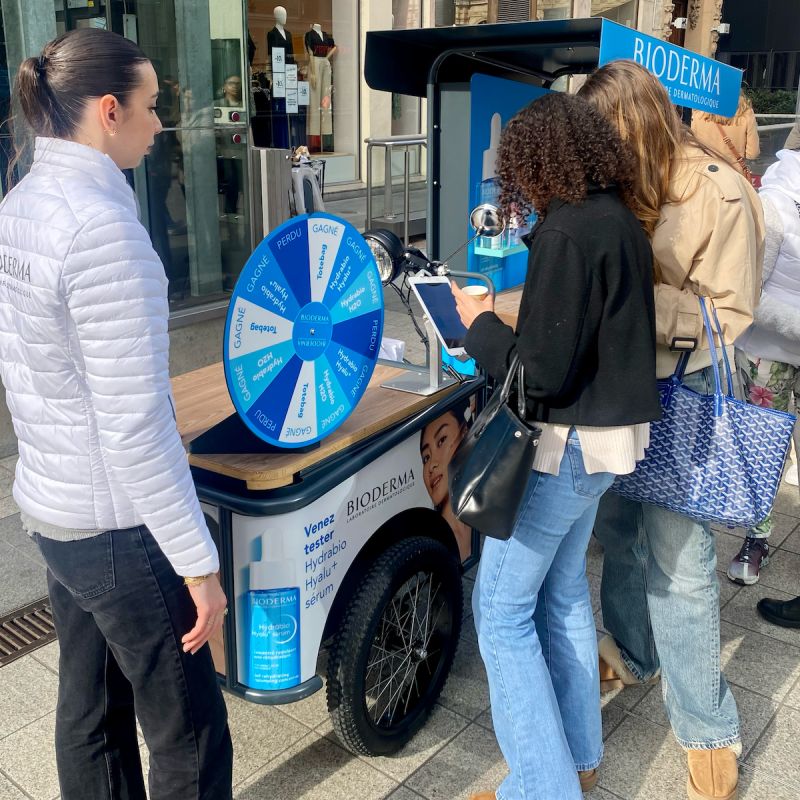
Bioderma: nationwide cargo bike tour across 5 cities with live product sampling and hydration testing.
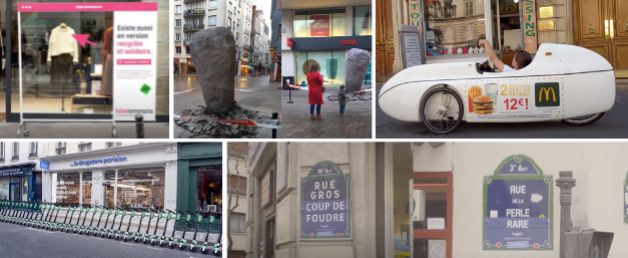
Le Drugstore parisien: "kidnapping" all e-scooters in the 7th arrondissement and gathering them in front of the store.
Emmaüs x Brainsonic: mobile clothing rails placed in front of fashion store windows on Black Friday to denounce overconsumption.
McDonald's Paris 12: a sports-car-shaped advertising bike used to attract passers-by in an unexpected way.
Street marketing is one of the few advertising formats where the brand goes to find the consumer, not the other way around. No scrolling required, no algorithm to convince: you are there, in the street, at the right place, at the right time. The result: brand recall rates that far exceed those of traditional outdoor advertising, and genuine viral potential when the activation is well designed.
But "street marketing" covers very different realities: from a simple sampling cargo bike to an urban installation that makes the national news. This guide covers the definition, the effectiveness figures, and five concrete examples of campaigns that genuinely worked in France.
Street marketing refers to all communication activities taking place in public spaces to create direct, often interactive contact with a targeted audience. The street becomes the advertising medium, and the passer-by the immediate recipient.
What sets street marketing apart from traditional outdoor advertising is the experiential dimension. A billboard informs; a street activation makes people feel something. This difference has measurable consequences on recall and engagement.
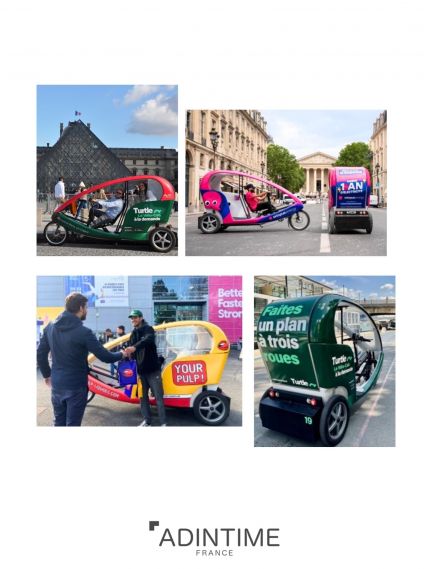
The most common formats include: flyer and freebie distribution, outdoor animations and demonstrations, unusual urban installations, advertising vehicles (bikes, cargo bikes, trucks), and guerrilla marketing operations. Each format serves a different objective, with varying budgets and levels of logistical complexity.
Street marketing vs guerrilla marketing: what is the difference?
The two terms are often confused, and understandably so: guerrilla marketing is a subset of street marketing, not a synonym.
Street marketing covers planned and legally framed actions in public spaces: sampling, animations, interactive devices, advertising vehicles. The legal framework is respected and the necessary permits have been obtained.
Guerrilla marketing pushes the dial towards radical surprise: unauthorised flyposting, stencils on the pavement, unsanctioned video projections, spontaneous urban happenings. The surprise effect is maximum, often striking. But the legal framework can be blurry, or outright crossed. Before launching a guerrilla operation, it is worth checking local regulations and making sure the creativity does not backfire on the brand.
For most advertisers, "managed" street marketing offers a better risk/impact ratio, largely because it allows results to be measured.
Why it works: key figures
Street marketing is often seen as a "PR stunt" format that is hard to measure. The available data suggest otherwise.
On recall: 78% of consumers exposed to a guerrilla marketing activation still remember the brand six months later, versus 35% for traditional outdoor advertising (Ipsos, 2024). 70% of people who interact directly with a street marketing operation spontaneously mention the brand in the weeks that follow.
On engagement: mobile advertising vehicles attract 2.5 times more attention than static panels. A well-organised street marketing event generates an average of +40% pedestrian traffic in the targeted area.
On return on investment: the average ROI of a successful activation is estimated at between €3 and €5 for every euro invested. This figure varies significantly depending on the creativity of the concept and its ability to generate organic reach on social media.
These figures are explained by a simple mechanism: public space creates a very different reception context from digital. The passer-by is not in "skip" mode; they are physically present, often surprised, and the emotion generated by an unexpected experience facilitates memorisation.
5 creative and intelligent street marketing campaign examples
1. Tilted panels for a clever campaign (IKEA x Buzzman, 2025)
In 2025, IKEA and agency Buzzman turned Gare Saint-Lazare into an advertising playground. Deliberately tilted panels caught the eye of thousands of daily commuters, with a simple message: IKEA offers a free screw-tightening service for wobbly furniture.
What makes this activation effective is not the technology or the budget, but the coherence between the concept and the message. The device illustrates the very problem it solves. The result: media coverage well beyond Gare Saint-Lazare, and brand recall likely higher than a straight billboard would have achieved.
2. Bioderma's experiential cargo bike
For the launch of its Hyalu+ serum, Bioderma ran a nationwide tour across five major French cities. The centrepiece: a cargo bike with live animation, product sampling and an on-the-spot hydration test.
The value of this format goes beyond simple distribution. A passer-by who tests a product in the street, in front of a branded activation, experiences something concrete rather than reading a claim. That direct contact explains the higher conversion rates compared to in-store sampling.
The campaign's specific results were not made public, but the cargo bike/experiential activation format is now one of the most widely used in the beauty industry.
3. The e-scooter kidnapping (Le Drugstore parisien)
To promote the Le Drugstore parisien concept store (Groupe Casino), the marketing team organised the "capture" of every shared e-scooter in Paris's 7th arrondissement and regrouped them in front of the store entrance.
The activation targeted its audience precisely: urban commuters who use e-scooters are exactly the customer profile the store is aimed at. The action is playful, non-intrusive, and highly photogenic — which explains its natural spread on social media.
4. Emmaüs's Hack Friday (x Brainsonic)
On Black Friday, Emmaüs and agency Brainsonic deployed mobile clothing rails in front of the windows of major fashion retailers. On each rail, a quiet message: this item is available in a recycled, solidarity-driven version on the Emmaüs website.
This is an example of strong-message guerrilla marketing without visual aggression. The activation slots into a context (the surge of shoppers on Black Friday) without violently disrupting it. It generates awareness rather than confrontation.
5. The next-generation advertising bike (McDonald's Paris 12)
The McDonald's in Paris's 12th arrondissement opted for an advertising bike with an unusual design: a sports-car-shaped body. The principle of the advertising bike relies on mobility and the unexpected — two strengths that explain why mobile advertising vehicles attract 2.5 times more attention than static panels.
A simple format, inexpensive compared to a fixed installation, that fully exploits the surprise effect in an urban environment saturated with advertising messages.
How much does a street marketing campaign cost?
This is the question that few articles on the subject dare to answer directly. Here is an honest breakdown.
For a simple local activation (flyer distribution, animation in front of a point of sale), budget between €300 and €2,000 depending on duration and the number of brand ambassadors. The average response rate for an event-based street marketing distribution with live animation is 15%, versus 3% for a simple letterbox drop.
For an activation with a creative device (cargo bike, installation, advertising vehicle), budgets start at around €3,000 to €5,000 for a single day in one city. A nationwide multi-city tour like Bioderma's is more likely to run €20,000 to €50,000 depending on the scale of the activation.
For a guerrilla marketing campaign involving an urban installation or unconventional device, design and production costs (including creative agency) often reach €15,000 to €40,000. The ROI can be very high if the activation generates press and social media coverage, but that is precisely what is difficult to guarantee in advance.
One thing is certain: street marketing is not reserved for big brands. With less than €2,000, it is possible to launch a local activation that effectively reaches a proximity audience.
Format comparison table
Format
Estimated budget
Reach
Key strengths
Best for
Flyer / freebie distribution
€300 – €2,000
Local, targeted
Low cost, direct contact, measurable response rate
Store openings, local promotions
Branded bike / cargo bike
€1,800 – €5,000/day
Local to regional
Mobility, 2.5× more attention than static ads, eco-friendly
Product launches, urban brand awareness
Experiential animation / sampling
€3,000 – €15,000
Local, high engagement
High conversion rate, memorable experience, data collection
Beauty, food & beverage, retail
Creative urban installation
€10,000 – €40,000
Local + viral potential
Strong brand recall, press and social media potential
Major brands, brand repositioning
Guerrilla marketing
€5,000 – €30,000
Local + national potential
Maximum surprise effect, 78% brand recall
Purpose-driven brands, one-off buzz campaigns
How to integrate street marketing into your strategy
Street marketing rarely works in isolation. Its effectiveness is multiplied when it is part of a cross-channel strategy: the physical activation generates content, that content circulates on social media, and digital amplification extends the reach well beyond the geographic area covered.
A few principles that separate the activations that make the national press from those that go unnoticed:
Concept/message coherence: IKEA's tilted panels work because the device illustrates exactly what it says. If the connection is not immediately readable to a passer-by, the activation loses its impact.
Photogenicity: an activation designed to be photographed travels on social media. Think about this from the very first design stage.
Geographic targeting: street marketing is only useful if you are in the right place. Le Drugstore parisien did not choose the 7th arrondissement at random.
Measurement from the start: set a quantified objective before launching (engagement rate, footfall at point of sale, social media mentions) so you can evaluate the result.
FAQ: everything you need to know about street marketing
What is the difference between street marketing and guerrilla marketing?
Street marketing covers all communication activities in public spaces that are planned and legally framed: animations, advertising vehicles, sampling, installations. Guerrilla marketing is a more radical derivative, relying on the unexpected and visual shock (unauthorised flyposting, stencils, happenings). The impact can be higher, but the legal and reputational risk is also greater.
How much does a street marketing campaign cost?
Budget ranges vary widely by format: from €300 for a local flyer distribution to €50,000 for a nationwide tour with an experiential device. The vast majority of street marketing activations for SMEs fall between €1,500 and €10,000, depending on duration, the number of brand ambassadors, and the creativity of the concept.
Is street marketing legal in France?
Managed activations (animations with a council permit, advertising vehicles, flyer distribution) are legal subject to obtaining the necessary authorisations. Unauthorised guerrilla marketing (flyposting, stencils) can result in fines. Always check with the relevant local authority before launching an activation.
How do you measure the ROI of a street marketing activation?
Several indicators can be used: number of direct interactions (goodies distributed, contacts collected), increase in pedestrian traffic in the area, sales uplift in the days following the activation, social media mentions and press coverage. The average ROI of a well-designed campaign is estimated at between €3 and €5 for every euro invested.
Does street marketing work for small businesses?
Yes, and that is one of its main advantages. Unlike a national TV or press campaign, street marketing can be calibrated to a precise catchment area with a limited budget. A one-day animation in front of your point of sale can generate +35% footfall and a 15% conversion rate, based on available field data.
Which sectors use street marketing the most?
The sectors that rely on it most heavily in France are beauty and cosmetics (experiential sampling), fast food and food & beverage, retail and department stores, and purpose-driven brands (charities, CSR-led companies) that want to create meaning rather than simply expose a logo.





 Top 30 best ad musics of all time (Updated 2026)
 The influence of advertising on purchasing behavior
 What is commercial advertising?
 Top 5 colors to use for creating your advertising posters | Adintime
 Facebook Ads Library: The ultimate guide to winning campaigns
 Movember : How brands can get involved without a misstep ?
 How to build an effective media strategy in 2026
 The AIDA model in advertising : Definition and examples
 First-party data : Definition and challenges in the cookieless era
 Customer Acquisition Cost (CAC) : Calculation and optimization