New ! Find your advertising panels at a glance  DISCOVER

Retail media : Definition, examples and benefits for advertisers

Pôle Marketing

Want to save time ?

Get this article summarized in seconds with AI

Article summary: Retail media

💡 An advertising channel in full explosion

  • Retail media represents around 1.3 to 1.5 billion euros in France in 2025, with an estimated growth of +20–25% per year (Observatoire de l'e-pub / SRI-UDECAM)
  • The principle: retailers (Amazon, Carrefour, Fnac Darty, Cdiscount...) sell advertising space to brands on their own platforms, leveraging their purchase data
  • It is the fastest-growing segment in French digital advertising, ahead of classic display and social

📊 What sets it apart from other formats

  • The data used is real transactional data (what customers buy, how often, in which category), not estimated socio-demographic profiles
  • Measurement is closed-loop: ad exposure → actual sale, which allows for calculating an ROI at the product level
  • Retail media is cookieless by nature, making it particularly resilient against the end of third-party identifiers

🎯 Concrete options for advertisers

  • On-site: sponsored products in search results or retailers' category pages
  • Off-site: activation of shopper audiences on the open internet via retailers' DSPs (Criteo, Amazon DSP)
  • In-store digital: DOOH screens in physical stores, CRM emailing to loyal customers

For years, consumer goods brands have invested in TV and billboards to build awareness, and used digital display to drive traffic. Retail media changes this logic: it places advertising right when the consumer is choosing a product, on the retailer's website, using real purchase data to guide targeting.

This is not a sudden revolution. It is the logical outcome of three simultaneous trends: the explosion of e-commerce, the planned phase-out of third-party cookies, and the rise of first-party data. Retailers who had accumulated years of transactional data realized it was worth its weight in gold for brands looking to activate it.

This guide explains what retail media is, why it is growing so fast, who the main players are in France, and how to practically get started.

Article table of contents

  1. Precise definition of retail media
  2. Why retail media is exploding?
  3. The main players in France
  4. Retail media on-site vs off-site
  5. Retail media vs classic display
  6. How to get started?
  7. Summary table
  8. FAQ

Precise definition of retail media

Retail media refers to all advertising formats sold by a retailer or an e-commerce platform to brands, either on its own assets or via audience extension, leveraging its first-party transactional data.

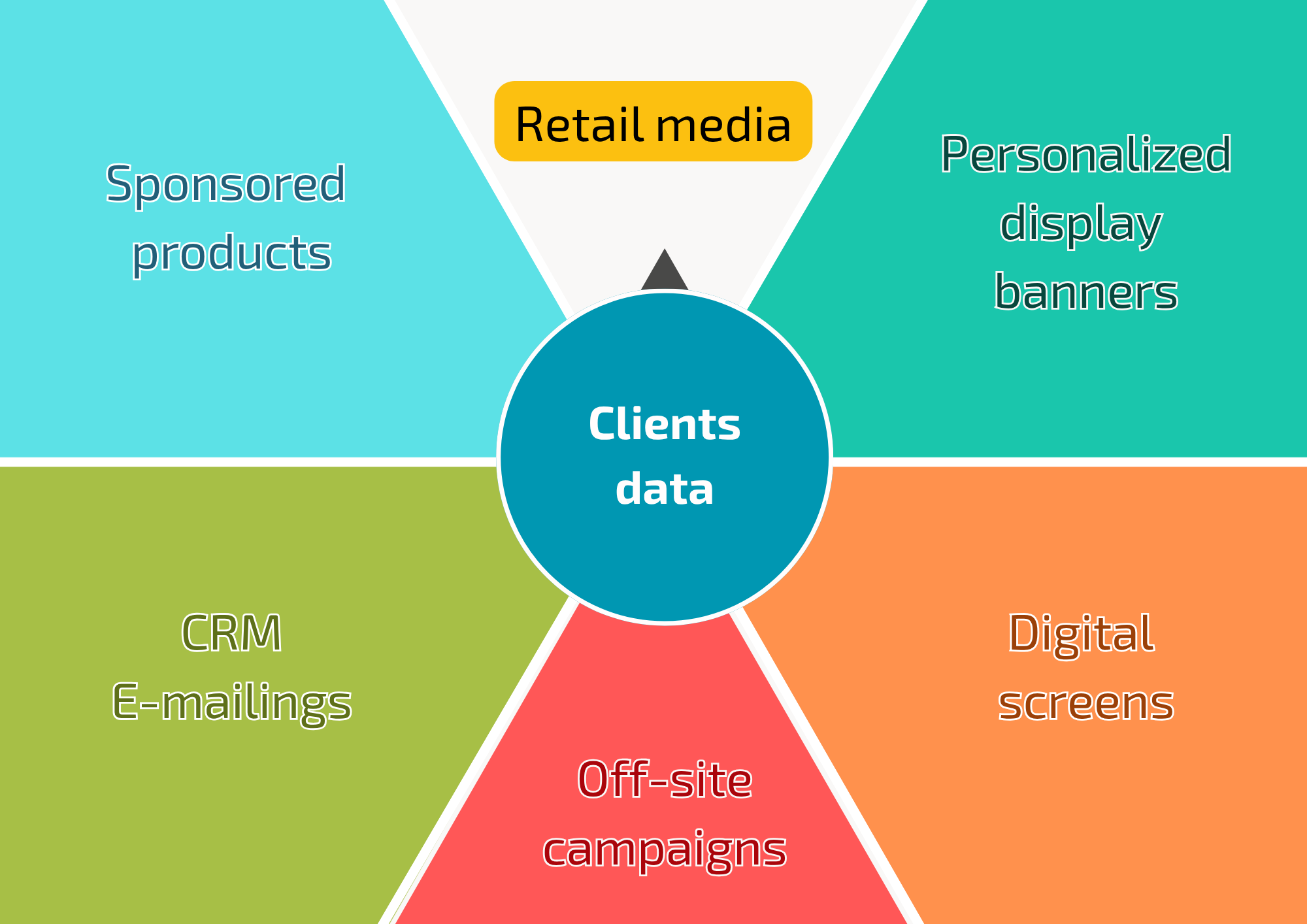
This is a broad definition, and intentionally so. Retail media covers very different formats: sponsored products that appear at the top of search listings on Amazon or Carrefour.fr, personalized display banners on Fnac.com, CRM e-mailings sent to Leclerc loyalty cardholders, digital screens installed in hypermarket aisles, and off-site campaigns targeting a retailer's visitors as they browse elsewhere across the web.

What unifies all of this is data. Unlike classic display advertising, which relies on socio-demographic profiles or contextual signals, retail media is anchored in real purchasing behavior: what this customer bought, in which category, how often, and what their average basket value is.

The English term has become standard in professional usage in France. Some also refer to it as "commerce media" for formats that extend beyond pure retailers (intent platforms like Leboncoin, price comparison sites, etc.).

Why is retail media exploding in 2025-2026?

Retail media has existed since Amazon launched its first sponsored formats. However, its growth has accelerated due to structural reasons that are here to stay.

  1. The end of third-party cookies: Third-party advertising identifiers, on which most display and programmatic targeting relies, are in decline. Safari and Firefox have been blocking them for years. Chrome has pushed back its own removal, but the signal is clear: targeting based on third-party data is set to shrink. Retail media, on the other hand, relies on first-party identifiers, customer accounts, loyalty cards, and checkout data. It is structurally cookieless.
  2. Closed-loop measurement: This is perhaps the most concrete benefit for advertisers. In classic display advertising, it is difficult to link an ad impression to an actual in-store sale. In retail media, the retailer sees the ad exposure and the purchase within the same system. They can calculate incremental sales, a market share uplift within the chain, and an ROI per SKU. For consumer goods brands accustomed to GRPs without direct attribution, this is a major breakthrough.
  3. E-commerce growth: The more purchases migrate online, the more retailers' product pages and search results become prime advertising spaces. Amazon understood this before anyone else: its advertising business now generates several tens of billions of dollars per year globally.

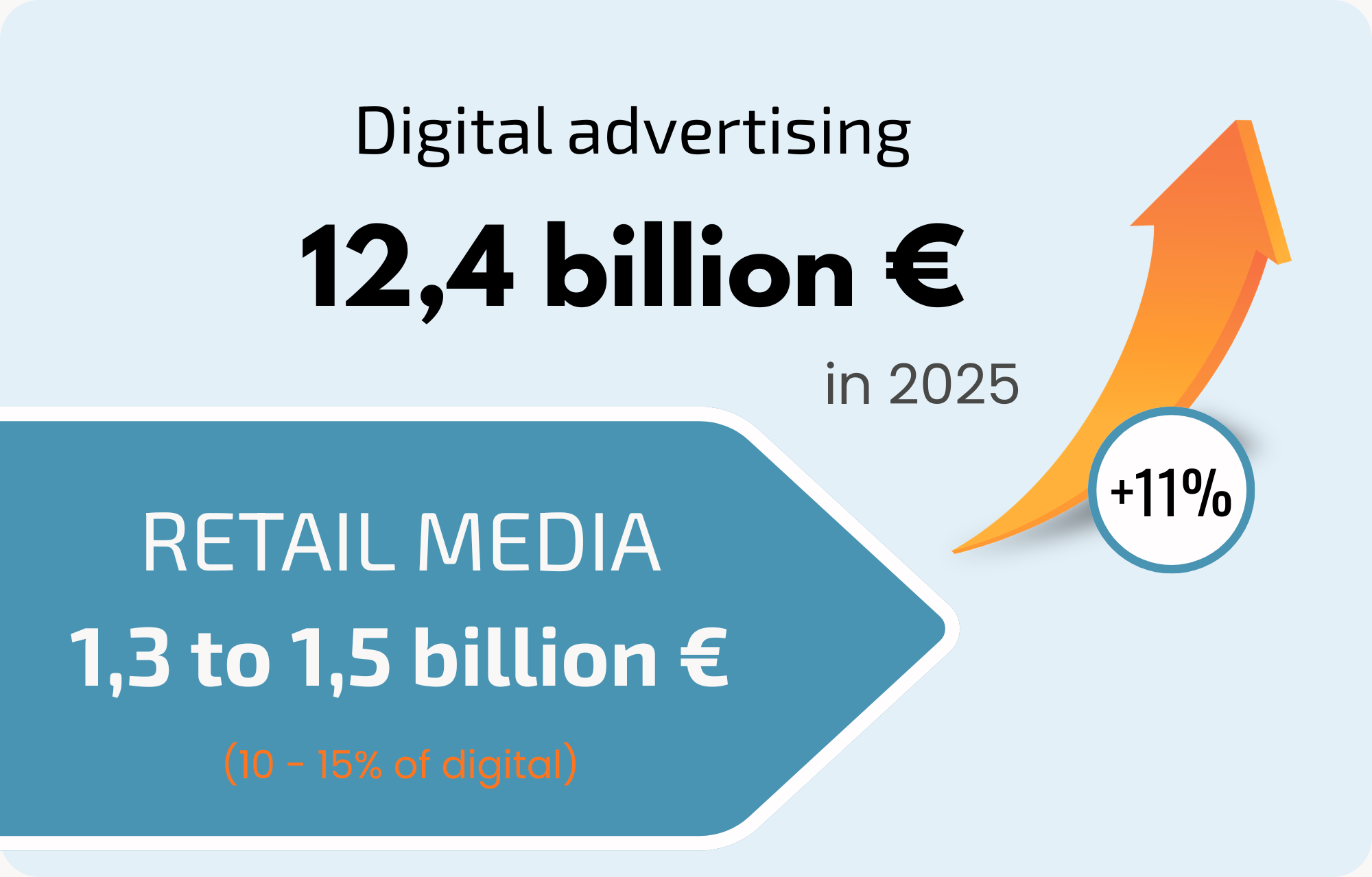
In France, the digital advertising market reached 12.4 billion euros in 2025, up 11% (Observatoire de l'e-pub, SRI/UDECAM). Retail media accounts for an estimated share of 10-15%, representing around 1.3 to 1.5 billion euros, with annual growth significantly higher than the rest of the digital market.

The main players in French retail media

The market is structured around three types of players: e-commerce pure players (Amazon), brick-and-mortar retailers that have digitized their offering (Carrefour, Fnac Darty), and technology platforms that aggregate multiple retailers (Criteo).

  • Amazon Ads is the undisputed global leader. In France, it combines the power of the most widely used search engine for online shopping with a DSP that extends Amazon audiences to the open internet and streaming video. For brands selling on the Amazon Marketplace, investing in Amazon Advertising is often the very first decision to make to maintain their visibility against competitors.
  • Carrefour Links is Carrefour's data and retail media platform. It allows FMCG brands to activate Carrefour customer audiences on-site, off-site, and in physical stores via DOOH and CRM. Carrefour's main strength: its checkout data covers millions of French households across decades of purchasing history.
  • Criteo occupies a unique position: it is a technology platform, not a retailer. It aggregates the inventory of more than 200 European retailers, allowing a brand to activate a "category buyers" audience across many sites simultaneously, without having to manage multiple points of contact. Its Retail Media solution covers sponsored products, on-site display, and off-site audience extensions.
  • Fnac Darty (via Fnac Darty Advertising) monetizes its audiences within the high-tech, cultural, and home appliance sectors, on-site on fnac.com and darty.com, as well as through CRM e-mailings sent to its loyalty cardholder base. For a brand launching a new tech product, this represents a highly qualified audience that is difficult to recreate elsewhere.
  • Cdiscount Advertising and Leboncoin Advertising complete the French landscape. Leboncoin occupies a hybrid position between retail media and intent media: its data on purchasing intent in automotive, real estate, or consumer goods makes it an original channel for brands seeking active buyers.

Retail media on-site vs off-site: what is the difference?

The distinction between on-site and off-site is fundamental to understanding retail media use cases.

Criterion ON-SITE Retail Media OFF-SITE Retail Media
Environment Displayed directly on the retailer's own properties. Activated outside of the retailer's own platforms.
Formats
  • Sponsored products (search results, category pages).
  • Display banners (homepages, product detail pages).
  • Native formats in recommendation feeds.
  • Targeted campaigns via DSPs (Amazon DSP, Criteo).
  • Display banners and videos across the open web.
  • Streaming video and social media.
Data & Signal Reaches consumers who are already in a buying phase active within the store. Activation of first-party audiences (e.g., targeting people who visited a specific category on the retailer's site). Based on real purchase signals.
Performance Explains the high conversion rates due to immediate proximity to the point of purchase. Acts as highly-qualified retargeting throughout the user's browsing journey.

The boundary between the two is shifting with the development of clean rooms and data partnerships. However, for an advertiser just starting out, the distinction remains useful: on-site captures buyers during the decision-making process, while off-site expands activation to a wider scope.

Retail media vs classic display: what really changes?

The two are not opposites; they address different stages of the buying journey. However, it is essential to understand the concrete differences before allocating a budget.

  • Classic display (banners via general networks, open market programmatic) remains relevant for awareness and consideration. It allows you to reach a large audience with a brand message at a controlled cost per impression. Its limitation is that targeting relies on imprecise declarative or behavioral profiles, measurement often stops at the click or website conversion, and it is dependent on declining third-party identifiers.
  • Retail media operates lower down the funnel. The purchase intent is already there. The data guiding the targeting consists of actual purchases, not estimations. Furthermore, measurement can track back to physical in-store sales via checkout data. In return, it is more heavily focused on consumers who are already in buying mode, making it less effective at creating intent where it does not yet exist.

For a coherent cross-channel strategy, the two are complementary: display builds brand preference, while retail media converts it into a sale.

How to get started in retail media?

The first question to ask is not "which platform to choose" but "where do my customers buy?". If your products are distributed on Amazon, starting with Amazon Ads is often the most natural choice because visibility on the search page is directly correlated with sales on the platform. If you are mainly in grocery mass retail, Carrefour Links or a multi-retailer solution via Criteo might make more sense.

Next, here are a few practical principles:

  • Entry budgets vary across platforms, but retail media is not reserved only for major brands.
  • Sponsored product formats on Amazon or Cdiscount are accessible in self-service starting from a few hundred euros per month.
  • For more elaborate setups (in-store DOOH, tailored CRM campaigns), minimum budgets are generally higher and require a direct business relationship with the retailer.

Measurement is the core strength of this channel, so leverage it! Systematically request an incremental sales report rather than settling for clicks alone. This is what allows you to distinguish campaigns that actually generated additional purchases from those that merely reached consumers who would have bought anyway.

>>> To master the calculation of your marketing campaigns' ROI

Finally, keep in mind that retail media is an investment in search rankings as much as it is in advertising. On Amazon in particular, sponsored campaigns influence organic ranking. A brand that abruptly cuts its retail media spend may see its visibility drop on both fronts.

>>> Operating on a limited budget? This article provides helpful pointers to prioritize channels

>>> Submit your brief on Adintime to launch your retail media strategy

Summary table: retail media vs classic display

Criterion 🛒 Retail media 🖥️ Classic display
🎯 Targeting data First-party transactional data (real purchases). Third-party cookies, socio-demographic profiles, contextual.
🔥 Purchase intent Very high (consumer in buying phase). Variable, often upper-funnel.
📊 Measurement Closed-loop: ad exposure ➔ actual sale. Impressions, clicks, website conversions.
🛡️ Post-cookie resilience Strong (login and loyalty data). More fragile, relies on alternative IDs.
🚀 Marketing role Conversion, market share, trade marketing. Awareness, consideration, reach.
💳 Starting budget From a few hundred € (self-service). Variable depending on networks.
📈 Growth 2024-2026 +20-25% / year
(fastest-growing segment)
+8-12% / year on average.

Retail media is not just another channel

For consumer goods brands in particular, retail media is changing the relationship with retailers. While shelf placement used to rely on annual commercial negotiations, retail media introduces a market dynamic: visibility within the retailer's search results is won through performance, in real time, based on ad relevance and offer competitiveness.

This represents both an opportunity and a challenge. Brands that grasp this logic early and invest in their retail media presence build a competitive advantage in the categories where they operate. Those that wait until their competitors have captured all the top spots on the most critical keywords will regret it.

>>> To complement your reading on complementary digital formats, check out our guide on digital advertising

FAQ: Everything you need to know about retail media

What is retail media?

Retail media refers to advertising formats sold by a retailer or an e-commerce platform to brands, either on its own assets (on-site) or via audience extension (off-site), by leveraging its first-party transactional data. Examples include sponsored products on Amazon, banners on Carrefour.fr targeting category buyers, or Fnac Darty's CRM campaigns.

Why is retail media growing so fast?

Three structural reasons: the phase-out of third-party cookies makes retailers' first-party data highly valuable, closed-loop measurement (ad exposure → actual sale) meets advertisers' demands for ROI, and the rise of e-commerce expands advertising spaces with high conversion potential. In France, the segment's growth is estimated at +20-25% per year over 2024-2026.

What is the difference between on-site and off-site retail media?

On-site retail media includes formats displayed directly on the retailer's own properties (sponsored products, banners on the website or app). Off-site retail media involves activating the retailer's first-party audiences outside of its own platforms, via DSPs (Amazon DSP, Criteo), to reach these consumers on the open internet, streaming video, or social media networks.

Who are the main retail media players in France?

The key players in France are Amazon Ads (global leader), Carrefour Links (grocery mass retail), Criteo (technology platform aggregating 200+ European retailers), Fnac Darty Advertising (high-tech, culture, home appliances), Cdiscount Advertising, and Leboncoin Advertising. Each offers different audiences and formats depending on the sector and the advertiser's goals.

Is retail media accessible to SMEs?

Yes, partly. Sponsored product formats on Amazon or Cdiscount are accessible via self-service starting from a few hundred euros per month. More elaborate setups (in-store DOOH, tailored CRM, managed campaigns) generally involve higher minimum budgets and a direct relationship with the retailer or its sales house team.

How do you measure the ROI of a retail media campaign?

Closed-loop measurement is one of the channel's key advantages. Essential metrics include: incremental sales (purchases directly attributable to the campaign compared to a control group), ROAS (revenue generated per euro invested), market share uplift within the chain, and cost per new customer acquired. Real sales indicators should be prioritized over exposure metrics (impressions, clicks) which tell you nothing about actual business impact.

Related products

Related posts